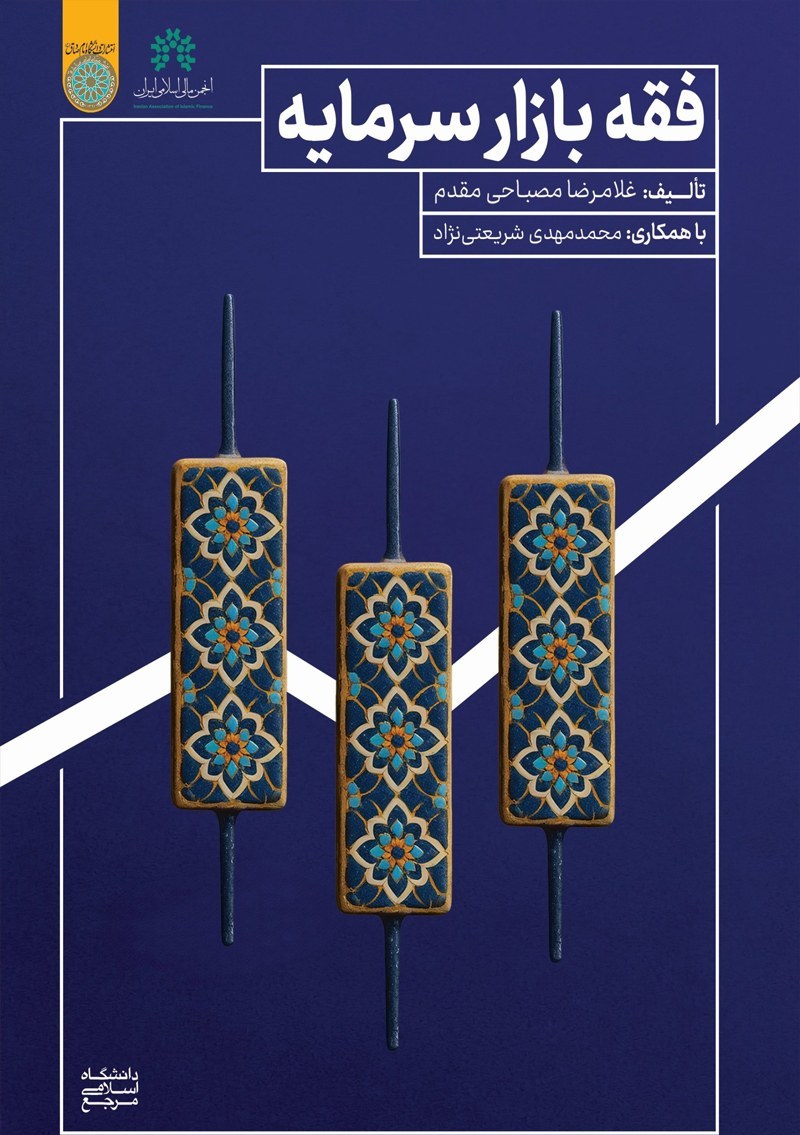
Jurisprudence of the Capital Market, written by Gholamreza Mesbahi‑Moghadam in collaboration with Mohammad‑Mahdi Shariati‑Nejad, is a specialized work in the field of financial jurisprudence and Islamic economics. Published by Imam Sadiq University Press, the book examines the juristic foundations of the Islamic capital market, Islamic financial instruments and institutions, and their conformity with the principles of Islamic law (Sharia).
The book has been compiled with the aim of elucidating the juristic foundations of the capital market and Islamic financial instruments. In the first chapter, the authors introduce different types of markets—commodity, money, currency, and capital—and discuss the fundamental differences between the Islamic capital market and the conventional one. The Islamic capital market is grounded in principles such as the avoidance of riba (usury/interest), gharar (excessive/risk-inducing uncertainty in a contract), gambling, and the wrongful acquisition of property (akl al‑mal bi‑al‑batil). Accordingly, all of its instruments and institutions must be compatible with Islamic law. Key characteristics of this market include the supervisory role of the Sharia board in overseeing transactions and instruments, transparency and justice in exchanges, and a focus on real assets.
The book then introduces the components and pillars of the Islamic capital market, including financial instruments (shares and Islamic securities), financial institutions (stock exchanges, investment banks, and investment funds), and related markets (primary and secondary markets). The authors examine in detail various types of companies, the concept of legal personality from both juristic and legal perspectives, and different types of shares and their characteristics. The buying and selling of shares, the leasing of shares, and the juristic rulings related to such transactions are also analyzed.
In subsequent chapters, Islamic financial securities—such as Murabaha (cost-plus financing), Salaf (forward contracts), Ijarah (leasing), Manfa’ah (usufruct), Ju’alah (commissioned performance), Istisna’ (manufacturing contracts), Wakalah (agency), Islamic reinsurance (Retakaful), energy-saving certificates, pre-emptive right certificates, capacity certificates, Islamic treasury bills, participation bonds, Mudarabah (profit-sharing partnership), Muzara’ah (sharecropping), Musaqat (agricultural partnership), and Qard al-Hasan (interest-free loans)—are examined individually. Each instrument is analyzed with reference to Qur’anic verses, narrations, and the opinions of jurists, and its application in Iran’s capital market is explained.
The third chapter addresses issues such as foreign exchange transactions, the forex market, derivative contracts (futures, options, and swaps), and copy or mirror trading, all of which are analyzed from a juristic perspective. The authors attempt not only to propose juristic solutions for utilizing modern financial instruments but also to identify and examine the challenges associated with them.
At the Islamic Finance Conference—held at the Securities and Exchange Organization and attended by a number of professors, researchers, and professionals active in financial markets—the book Jurisprudence of the Capital Market was selected as the best book in Islamic finance.
It is noteworthy that Gholamreza Mesbahi‑Moghadam is a faculty member at Imam Sadiq University. His academic record includes the authorship of seventeen specialized research books on Islamic economics, the publication of more than thirty educational and research articles in reputable national journals and international conferences, the establishment of two programs in Fiqh al‑Iqtisad (jurisprudence of economics) at Imam Sadiq University, the supervision of approximately thirty doctoral dissertations and more than fifty master’s theses, and teaching at Imam Sadiq University with the rank of full professor. He has also taught advanced jurisprudential seminars (dars‑e kharej) on economic jurisprudence—such as jurisprudence of money and banking and jurisprudence of stock market transactions—in the seminaries of Qom and Tehran, as well as courses on jurisprudence and jurisprudence of economics in both seminary and university settings.