
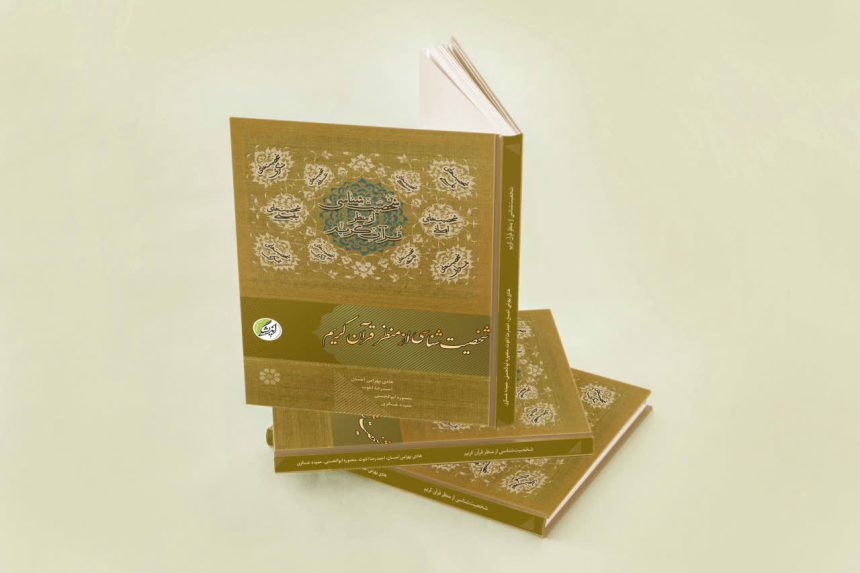
The book “Personality Psychology from the Perspective of the Holy Qur’an,” written with an innovative and indigenous approach by Hadi Bahrami Ehsan, Ahmadreza Okhovat, Mansoureh Abolhasani, and Hamideh Askari, has recently been published by Andishegi Publications and released to the book market.
Personality psychology is regarded as one of the foundational domains of psychology. The diversity of perspectives in defining personality stems from differing approaches to the nature of the human being. This work seeks to revisit revelatory sources in order to present a renewed understanding of the reality of the human being and the structure of human personality, thereby forming the basis of Quranic personality psychology.
The Holy Qur’an offers a distinct and profound framework for explaining human personality through concepts such as fitrah (innate human nature), nafs (the self or soul), and shakilah. Among these, the concept of shakilah—understood as the inner and foundational structure of personality—plays a central role in explaining individual differences and the behavioral orientations of human beings.
According to this perspective, human behavior and actions are reflections of one’s existential shakilah. Shakilah constitutes the deepest layer of distinction among individuals and indicates the manner in which they incline toward guidance or misguidance.
With the concept of shakilah as its central focus—presented as the Qur’anic term closest in meaning to “personality”—the book Personality from the Perspective of the Holy Qur’an examines the structure and dimensions of human personality from the standpoint of divine revelation. Drawing on verse 84 of Surah al‑Isra and other related verses, the authors introduce shakilah as the root of behavior and individual differentiation, demonstrating that human actions reflect one’s inner structure.
The book is organized into four chapters. The first chapter addresses general concepts and the semantic analysis of shakilah and personality. The second chapter categorizes personality in terms of life orientations, focusing on the Qur’anic expression “min al‑nas” (“among the people”). The third chapter examines social and collective distinctions with particular attention to the term “qawm” (“people” or “community”). The fourth chapter presents a synthesis and classification of various personality groups based on Qur’anic findings.
After analyzing the lexical and technical meanings of shakilah, the authors define it as the dominance of the self over action and as the factor that determines the scope and ease with which behaviors are performed. They then examine the relationship between shakilah and concepts such as sabil (path or course of life) and aptitude, showing that each individual, according to their shakilah, chooses different paths in life—paths that are associated with either guidance or misguidance.
In subsequent sections, drawing on numerous Qur’anic verses, the book classifies personalities according to life orientations (divine or non-divine). For instance, through an examination of the phrase “min al‑nas” in various surahs, human beings are divided into groups such as believers (those who turn toward guidance), disbelievers (those who turn away from guidance), and the wavering or unstable. The personality characteristics of each group are analyzed in relation to their relationship with God, rational criteria, personal interests, other people, worldly affairs, and their own selves.
In the final chapters, the authors classify types of shakilah within three domains—perception, attention, and action—and examine the role of social responsibility, individual and social roles, and the influence of internalized traits on an individual’s behavior and position within society. Overall, the work presents human personality, from a Qur’anic perspective, as a multidimensional and dynamic phenomenon influenced by traits, capacities, and both internal and external orientations.
By theorizing personality on the basis of the teachings of the Qur’an and the hadiths, the authors aim to present a coherent, purpose-oriented framework consistent with Islamic culture, while also paving the way for overcoming the crisis of reductionism in dominant theories and moving toward the production of indigenous knowledge.