
1.
The human being is the strangest creature in the realm of existence. Despite possessing intrinsic dignity and superiority over most other beings, the ultimate station of the human oscillates between being lower than cattle—“They are like cattle; rather, they are even more astray”—and rising beyond the angels—“Then he was at a distance of two bows’ length or nearer”. This station depends entirely on one’s own voluntary choice and deliberate selection: by making use of the resources at one’s disposal, one may take the path of “either grateful” or stray into the misguidance of “either ungrateful.” God has provided both the inner and outer means necessary for human exaltation; yet most people, instead of employing these divine gifts on the path of elevation, use them as instruments of decline: “Perish man! How ungrateful he is.” Ingratitude toward a blessing consists precisely in using it outside its proper and rightful place.
2.
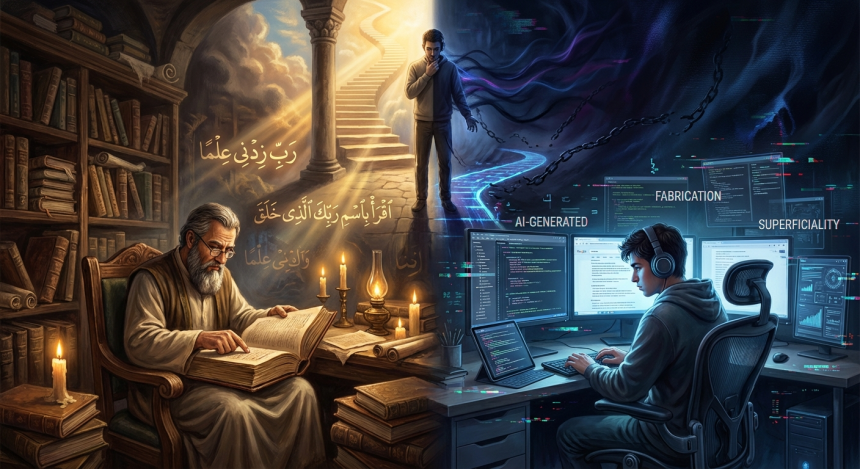
One of the most precious divine blessings of our time is the multitude of technologies that have expanded, facilitated, and rendered extraordinarily productive various dimensions of human life. Among these invaluable resources are educational and research technologies, whose unparalleled benefits for scholarship and the advancement of knowledge are truly astonishing and deserving of profound gratitude to the Divine. These benefits are far too extensive to be detailed in this brief account. Yet, by comparing our current situation with the meager resources available to earlier generations, the almost unimaginable distance between us and them becomes somewhat comprehensible. One professor used to recount, quoting his own teacher: “I had once seen a narration in the noble book Biḥār al-Anwār, but I had not written down its reference. I went through the entire Biḥār from beginning to end twice in order to find that narration!!!” Astonishing! Twice—that is, two hundred volumes of books!!! Imagine how many hours or days leafing through two hundred volumes would require. Now compare this with searching for the key words of a narration on the internet or in a software program such as Jāmiʿ al-Aḥādīth.
3.
Yet there is another side to this story as well. That venerable scholar, in the path of knowledge and research, possessed such lofty aspiration and iron resolve that he would leaf through two hundred volumes simply to locate a single ḥadīth. We, however, in our own time, sometimes lack the patience even to locate the text of a single narration using technological tools, contenting ourselves instead with what we have merely heard from others. And the story does not end here; rather, it has an even more lamentable continuation.
4.
With deep regret, contemporary technologies—rather than being employed by students and researchers to expand, accelerate, facilitate, and refine scholarly inquiry—have become tools for “compensating for laziness” and for “evading the hardship of research.” Until yesterday, in studying recent works, we were concerned about the “copy-and-paste” appropriation of others’ research. When machine-translation engines appeared, we began to scrutinize the errors of Mr. “Google Translate.” But now the situation has become more critical. To verify the authenticity of a student’s article, we ourselves must conduct research. The artificial intelligence employed by the author of the paper puts our natural intelligence to the test. An AI-generated article observes editorial and stylistic conventions with such precision that it makes the evaluator feel embarrassed by comparison. It cites, with such confidence, an article purportedly published in a journal with an impressive-sounding title that one might imagine the author had written that article as well. Yet when the evaluator’s natural intelligence is not deceived by these outward appearances and undertakes the labor of genuine inquiry, the truth is revealed: the bitter truth of fabricated article titles and even fabricated journal titles produced by artificial intelligence.
5.
Undoubtedly, institutions responsible for the governance of science must establish precise and technical regulations governing the manner and extent of the use of these technologies in scholarly research, along with very (I emphasize, very) strict penalties for violations of these rules. Otherwise, the monster of abuse by those who misuse artificial intelligence—with its terrifying power and oceanic scope—will give rise to a grave crisis for human knowledge.
Mehdi Abdollahi