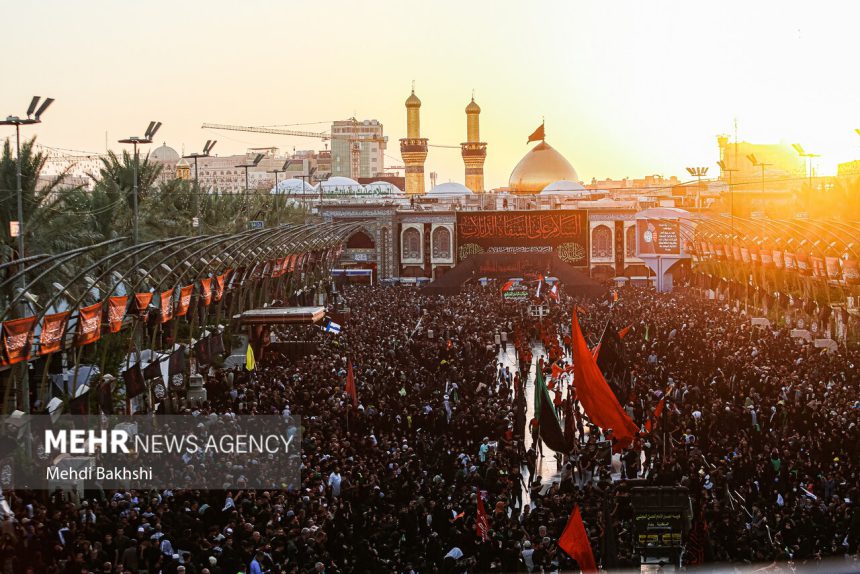

I returned from Iraq a few days ago. I was there to participate in the Arbaeen Procession—the pilgrimage that marks the fortieth day after Ashura, the anniversary of the epic battle that Imam Husayn and his several dozen loyal devotees fought against the army of Yazid, a formidable force of over thirty thousand men.
The Arbaeen Procession is arguably the largest religious annual pilgrimage in the world. Every year over ten million believers from across the world flock to Iraq to visit the shrine of Imam Husayn on this significant religious holy day.
It is not an easy trip. Although Iraqis are an exceptionally hospitable people, the convergence of so many millions of people in such a narrow timeframe necessarily leads to obvious problems and difficulties. Sanitation is perhaps the most salient issue. The physical infrastructure of very few countries—to say nothing of Iraq, which has still to recover from the ravages of war inflicted by the U.S.—is designed to accommodate such a colossal crowd. The amount of refuse created by millions of pilgrims is staggering, and despite Iraqis’ best efforts, the streets and roads are necessarily strewn with garbage.
The force of the elements is another major problem. The sweltering summer heat of the holy cities of Najaf and Karbala, where the pilgrims are primarily concentrated, is potentially fatal. Certainly, such heat is regarded as beyond dangerous in most countries around the world.
Another difficulty that believers face on this pilgrimage concerns restrooms and showers. Given the limitations of the available infrastructure, it should come as no surprise that, especially as you get closer to the Day of Arbaeen, every public restroom that you visit will have a queue that keeps you waiting for at least a few minutes. There is scarcely a time when you can enter a restroom on the path of pilgrimage, walk straight into a toilet stall, and relieve yourself without having to worry about the queue of desperate people eagerly awaiting their turn on the other side of the door.
Considering the amount of sweat that the body produces when one walks for extended periods of time in Iraq’s sweltering heat, the importance of showering cannot be overstated. As such, showers constitute an eagerly sought-after necessity in the course of the Arbaeen Procession. You would be lucky if you could find a clean shower where you could comfortably wash yourself without being burdened by the anxiety wrought by the presence of exhausted pilgrims standing in line outside the door.
And yet, despite these significant difficulties, which to a Westerner may seem nightmarishly daunting, the sense of peace and calm and the spirit of fellowship that one genuinely feels in the course of this pilgrimage are extraordinary. People do not bicker, despite the heat and the exhaustion, over their turns to use the limited number of restrooms and showers. It would be out of the ordinary for one to encounter even the most innocuous quarrels on this pilgrimage.
The path of the Arbaeen Procession from Najaf to Karbala is lined on both sides with an unbroken chain of service stations (mawākib) whose hosts, mostly Iraqi, have generously committed their time and wealth to humbly serving the pilgrims. The plentiful variety of foods and drinks that are served along the path of the procession is amazing. It would not be hyperbole to say that pilgrims have to contend with an overabundance—rather than a shortage—of food.
The stories of the Iraqi hosts and the commitment they feel to the pilgrims visiting the shrine of Imam Husayn stretch the limits of credulity. Many of the hosts are not affluent individuals with a comfortable margin of disposable income. Rather, they set aside a significant portion of their income throughout the year to be able to serve the pilgrims of Arbaeen.
The variety of pilgrims, too, is a wonder that does not cease to amaze: old men and women barely able to walk, physically frail individuals with serious mobility challenges, and young boys and girls who have chosen, in the face of all the seductive entrapments of sensual pleasure presented by the array of personal technologies available to them, the path of sublime love and sacred fellowship. One is truly left speechless by the breadth and depth of the reach of genuine devotion. Unlike most—if not all—religious festivals observed by other faith communities, there are truly no worldly attractions that could function as partial incentives in the pilgrimage of Arbaeen. To embark on this pilgrimage, the believer earnestly chooses to relinquish all the creature comforts to which he or she is accustomed and to endure difficulties and hardships that most people around the world would find too unpleasant to put up with voluntarily.
I have personally seen young men walk the baking path of the procession barefoot. I have seen a seventy-odd-year-old Kurdish Iranian woman with no knowledge of Arabic who had trouble walking and had lost her passport and been separated from her group, and yet I could not detect the least bit of panic or anxiety in her countenance or demeanor. I have seen young mothers making the pilgrimage with two or three young children in tow. It is beyond comprehension what you come across on the several-day journey from Najaf to Karbala.
The pilgrimage of Arbaeen is a prime example of how genuine and loving submission to the authority of the divine guides—the holy imams—can engender and nurture true love and fellowship. Throughout the procession, there is this ubiquitous phrase that one cannot help but notice, as it is emblazoned on many of the flags and banners that hang along the path: “The love of Husayn brings us together.” The phrase is one hundred percent—and I mean this without the least bit of exaggeration—genuine.
Iraqis and Iranians, though united by a shared faith, partake of vastly divergent cultural norms and customs. This is complicated by sensitive sticking points that have historically been a source of friction between the two nations. Additionally, both Iraqis and Iranians harbor a very strong sense of national pride. In fact, anti-Arab sentiment is a fairly strong undercurrent in Iranian culture, just as anti-Persian sentiment is an undeniable element within the Iraqi and the broader Arab culture.
Despite all these impediments, however, the millions of pilgrims who come together to commemorate the Day of Arbaeen display an amazing spirit of religious solidarity and fellowship. While the presence of the language barrier and the conflicting customs means that the common factors that naturally make for a strong spirit of unity are lacking, the overflowing love and fellowship manifested in the course of this millions-strong collective exercise of devotion to God’s most beloved beings are, for the lack of a better word, incredible—in the truest sense of the word, meaning “beyond belief.”
There are really no conventional factors that can be cited as accounting for this spirit of love and fellowship. As I alluded to in the above, historical and cultural factors would seem to militate against this transnational solidarity. Moreover, the United States has for the past two decades utilized every tool in its arsenal to weaken the bonds of shared faith and history that connect Iran and Iraq. In its misguided attempt to reshape the “Middle East” (that is, West Asia), the U.S. government exhausted every resource to stoke the flames of disunity and conflict among the various ethnicities and nationalities of the region.
Yet, to the chagrin and bafflement of Western political elite, the people of the region, especially the Shiites, have grown increasingly closer, their unity reinforced—rather than compromised—by the malevolent activities of America and its proxies. There is no explanation for this seemingly inexplicable state of burgeoning solidarity between the people of Iran and Iraq other than the higher, prevailing force of divine guardianship (walāyah), which takes control of world affairs and neutralizes and dominates the conventional determinants of societal and political trends when believers collectively manifest their wholehearted submission to the authority of the divine guides.
This constitutes a causality of a higher order. It is not at odds with the conventional factors that students of societal and political phenomena examine. It, rather, belongs to a higher order of reality, transcending the ordinary factors that make sense to political actors and thinkers. And it is precisely for this reason that the phenomenon of the Arbaeen Procession is fundamentally inscrutable to the U.S. political and military leadership.
By submitting to the authority of the divine guides, the holy imams, the Shia community is transformed into one body whose soul is the sublime reality of the holy imams. As such, despite all the fissures and disagreements that plague the community of the faithful, believers are unified in their common pursuit of the ultimate objective of the true faith—the establishment of the kingdom of God on earth under the leadership of Imam Mahdi, with the assistance of Jesus Christ.
Times of crisis offer an exceptionally clear view of the underlying unity of the community of the faithful under the guardianship of the holy imams. For nearly six months now, Iran—a “third-world” country suffering from decades of crushing economic sanctions, preceded by eight grueling years of all-encompassing war—has been engaged in an intense military conflict with the sole global superpower, the United States of America, with a military budget one hundred times greater than that of Iran. In the very first hours of the war, American fighter jets bombed the residence of Ayatollah Sayyid Ali Khamenei, the former supreme leader of Iran, killing him instantly. In the following days, dozens of Iran’s senior political, military, and security figures were also killed in American bombings.
The martyrdom of these highly committed believers, chief among them the slain supreme leader, was very painful for Iranians. Yet, their death, rather than stemming the tide of Islamic ascendancy, nourished and replenished it. A very interesting fact that I noticed in this year’s Arbaeen pilgrimage was the ubiquity of the pictures of the martyred Supreme Leader and his son, the newly appointed supreme leader of Iran, Ayatollah Sayyid Mojtaba Khamenei. Even the teahouses and kebab joints surrounding the shrine of Imam Husayn in Karbala, often viewed as the stronghold of American-aligned religious figures opposed to Iran’s political establishment, had pictures of the former and current supreme leaders displayed on their walls. The contrast with last year’s pilgrimage was inescapably stark. Like I said, when the community of the faithful is united in its submission to the divine guides, the malevolent activities of the forces of evil are not only futile but actually serve to strengthen the faith.
Another difference that I noticed compared to last year’s pilgrimage was the far more heightened awareness of Imam Mahdi—the twelfth imam of the Shia faith who has for the past eleven centuries been living in a state of “occultation” (ghaybah). Flags adorned with the slogans “Labbayka yā Mahdī” (“We are ready, O Mahdi”) and “Yā lathārāt al-Ḥusayn” (“Rise, O avengers of Husayn”), the latter being Imam Mahdi’s rallying cry upon his reappearance, were everywhere. There was, as I saw it, a notable increase in the believers’ sense of anticipation for the coming of the awaited Imam. This, I have no doubt, is in large part due to the martyrdom of the late supreme leader. The unjust spilling of holy blood has inevitable transformative consequences that reverberate throughout the cosmos, the extent of change they effect depending on the spiritual stature and purity of the slain soul, and on both counts, Ayatollah Sayyid Ali Khamenei was, as attested by friend and foe, an exceptional figure.
This year’s Arbaeen pilgrimage, therefore, felt truly different. There was, one could definitely sense, change in the air. Being present in the flowing river of pilgrims restlessly making their way to the shrine of Husayn, the earthly throne of his ever-radiant luminous soul, one felt as if one were suspended in a secure tunnel of light from which the tumultuous world on the outside appeared to be churning in a seething storm of unrest.
Only God knows what seismic events will unfold by next year’s Arbaeen pilgrimage. My guess is that America’s decline will accelerate, the community of the faithful will grow stronger and more assertive, and the reshuffling of the global order will pick up speed. I have no doubt, however, that one truth will remain unchanged: Imam Husayn will continue to exercise his salvific power, drawing believers more securely into the embrace of his love and paving the way for the emergence of his avenger, Imam Mahdi.
The Arbaeen Procession is a collective journey from mundaneness to sublimity, from individual disconnectedness to congregational unity, from the confusion of daily life to the certainty of submission to God’s viceroys. The essence of this endeavor of faith is renewing one’s pledge of allegiance to the Imam and repairing and bolstering the bonds of fellowship with one’s brothers and sisters in faith. That is the ultimate pilgrimage.