
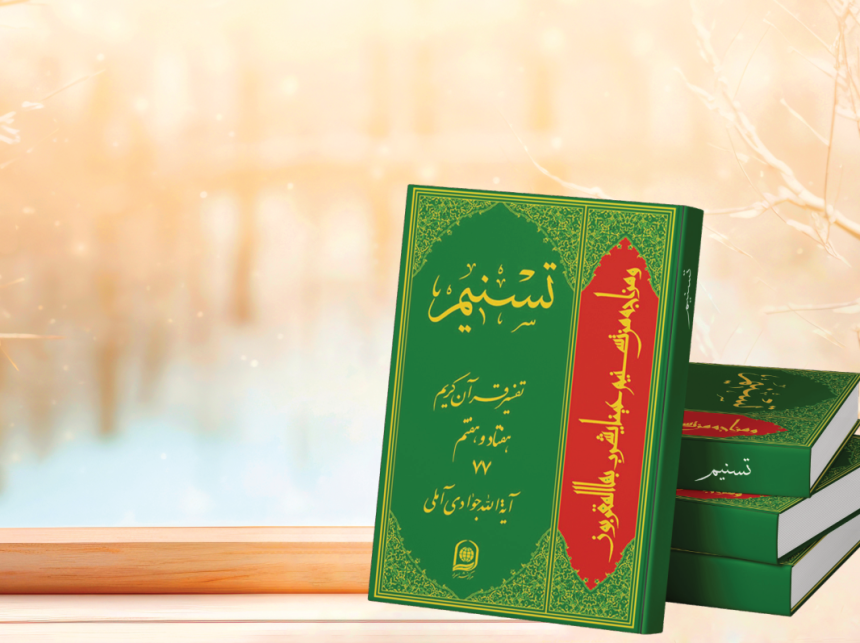
Book Review: Tafsīr-i Tasnīm (simplified herein as Tafsir Tasnim)
Author: Āyatullāh ʿAbdullāh Jawādī Āmulī
Reviewer: Mohammad Lotfipour
Bibliographic Information: Jawādī Āmulī, ʿAbdullāh, Tasnīm, 80 vols. Qom: Esra Publishing Center.
Tafsir Tasnim, regarded as a precious repository of pristine Qurʾānic knowledge, is the distilled result of the blessed lifetime of a sage with a comprehensive outlook. It has been composed on the basis of firm methodological principles such as interpreting the Qurʾān through the Qurʾān, conformity with the definitive narrations, and the harmonization of reason (ʿaql) and transmitted sources (naql).
This monumental work, by avoiding any form of one-dimensional interpretation and by drawing upon diverse Islamic sciences, offers a holistic and systematic portrayal of the Divine Message. Its methodological innovations—such as the careful differentiation between exegesis (tafsīr), subtle allusions and insights (ishārāt wa al-laṭāʾif), and narrational discussions (baḥth riwāyī)—enhance its scholarly rigor and reliability, turning it into an exemplary model for Qurʾānic commentary.
Tasnīm, with a sound understanding of contemporary intellectual needs, effectively addresses modern ideological and intellectual doubts, and elucidates socio-political and governance-related issues on the basis of the Qurʾān—without falling into reductionism or personal conjecture. Its comprehensiveness, depth, verifiability, and inclination toward rapprochement (taqrīb) constitute further outstanding merits, making its use indispensable for any serious researcher in Qurʾānic studies.
Undoubtedly, Tasnīm is not merely a commentary; it is an encyclopedia, an intellectual school, and an enduring legacy that enables a profound and contemporarily relevant understanding of the Noble Qurʾān for both present and future generations. It provides a roadmap for connecting individual and collective life with the living and dynamic teachings of divine revelation.
1. Introduction
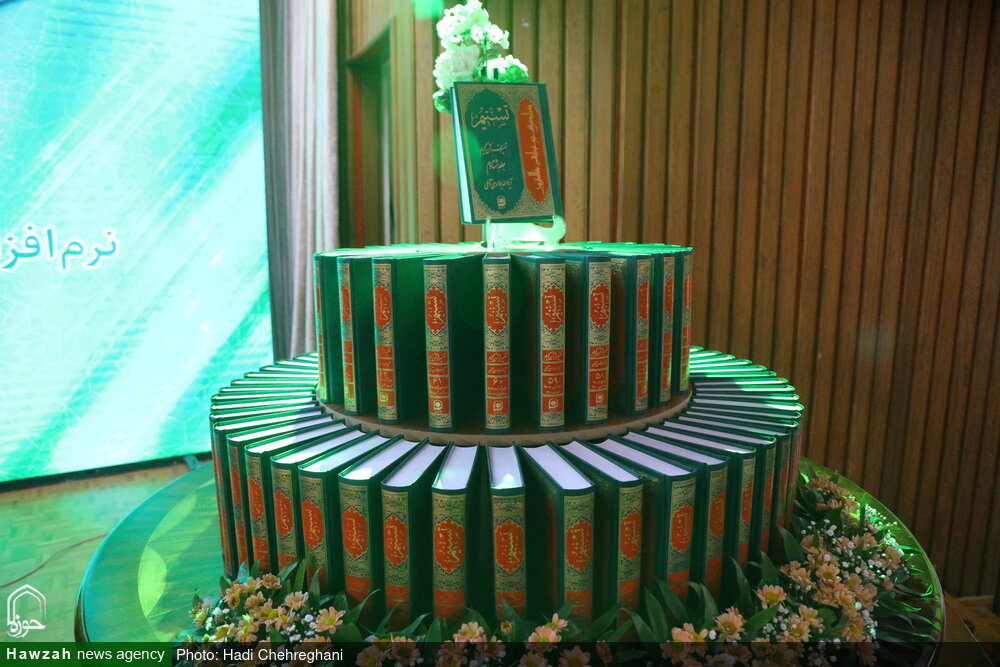
The exegesis of the Noble Qurʾān, as one of the loftiest objectives of Islamic sciences, has always attracted the attention of scholars and researchers. Among Qurʾānic commentaries, Tafsīr-i Tasnīm—the invaluable work of Āyatullāh ʿAbdullāh Jawādī Āmulī in Persian—occupies a distinguished position as one of the most comprehensive and systemically-structured tafsīrs of the modern era. This monumental work, the fruit of nearly four decades of continuous Qurʾānic instruction in the Seminary of Qom, encompasses the entirety of Qurʾānic verses in eighty volumes.
Tasnīm is not merely a sequential commentary; it is a vast encyclopedia of Qurʾānic sciences and Islamic teachings, written upon firm rational, transmitted, and mystical foundations. Its methodological rigor, its simultaneous attention to both the outward (ẓāhir) and inward (bāṭin) dimensions of the verses, its engagement with contemporary intellectual challenges, and its elucidation of social and governmental doctrines derived from the Qurʾān, are among the features that render this tafsīr an unparalleled resource for researchers, seminary students, and all seekers of a deep and systematic understanding of the Qurʾān.
The present study offers a concise survey of the various dimensions of this enduring work—from its history of compilation and exegetical foundations to its structural features and distinctive methodological approaches.
2. A Brief Biography of the Author
Āyatullāh ʿAbdullāh Jawādī Āmulī was born in 1933 in the city of Amol, northern Iran, into a family of religious scholars. He began his seminary education in the ḥawza of Amol and later moved to Tehran, eventually settling in Qom to continue his advanced studies. In Qom, he benefited from the instruction of prominent scholars such as Āyatullāh Burūjirdī, Imam Khomeini, Mīrzā Hāshim Āmulī, and ʿAllāma Sayyid Muḥammad Ḥusayn Ṭabāṭabāʾī, acquiring mastery in various disciplines including jurisprudence (fiqh), principles of jurisprudence (uṣūl), philosophy, mysticism (ʿirfān), and exegesis.
He was among the notable figures of the Islamic Revolution and played an active role in the anti-Pahlavi movement, especially during the events of 5 June 1963. Following the Revolution, he served on the High Judicial Council and contributed significantly to the drafting of the Constitution of the Islamic Republic.
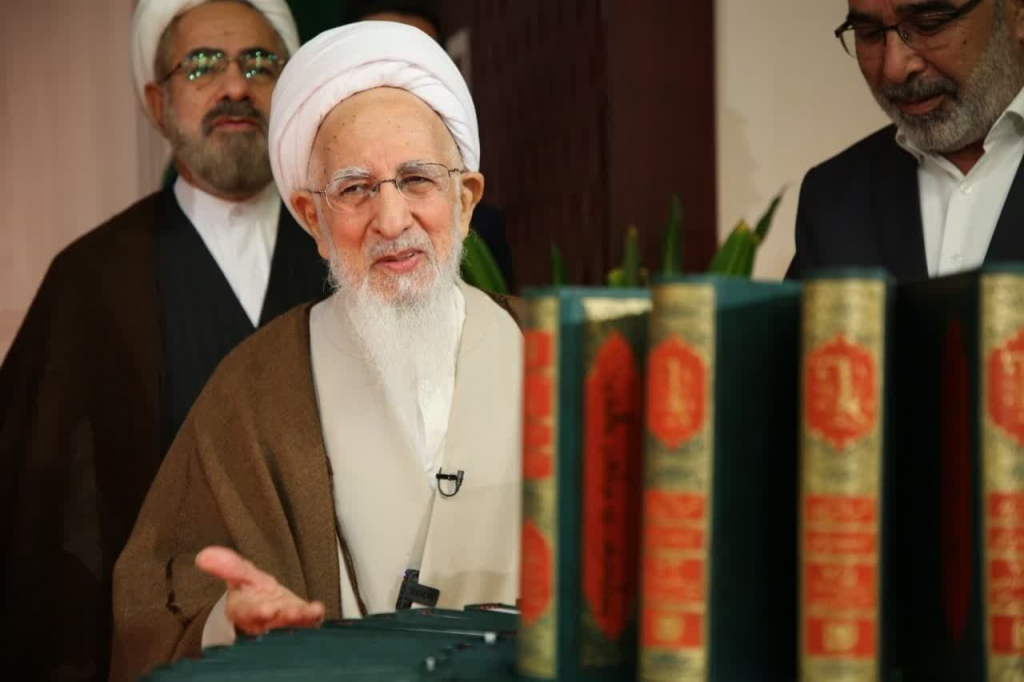
Āyatullāh Jawādī Āmulī is recognized as one of the foremost Qurʾānic exegetes of the contemporary period. He began teaching sequential Qurʾānic exegesis in 1982 at the Qom Seminary, a scholarly endeavor that eventually culminated in the production of the esteemed Tafsir Tasnim. Among his other notable contributions are numerous scholarly journeys to Islamic and European countries for the exposition of Islamic and revolutionary principles. These include his historic mission to deliver Imam Khomeini’s message to Mikhail Gorbachev, leader of the Soviet Union, and his delivery of Āyatullāh Khamenei’s message to the Millennium World Peace Summit of Religious and Spiritual Leaders in the year 2000.
Āyatullāh Jawādī Āmulī has authored an extensive corpus of works—exceeding 350 volumes—across various fields of Islamic sciences, all published by Esra Publishing Center. This vast body of scholarship attests to his intellectual breadth, methodological innovation, and substantial contributions to contemporary Islamic thought.
3. History of the Tafsīr Lectures
Āyatullāh Jawādī Āmulī became the founder of the formal course in Qurʾānic exegesis in the seminary in 1982. He recounts the beginning of this path as follows:
“After finishing the daily lessons in the Saʿādat Seminary, while having no plan whatsoever for the following day’s teaching, suddenly—and without any prior deliberation or consultation—an inspired divine prompting kindled within my mind the spark of tafsīr. The teaching began right there in the Saʿādat school, but very quickly, by God’s grace, the students’ overwhelming reception led the class to be relocated successively to the Mahdiyya, then the Muḥammadiyya Mosque, and finally, within a short time, to the Aʿẓam Mosque.”
Due to his profound dedication to the Qurʾān, this course became the longest uninterrupted period of Qurʾānic exegesis instruction in the contemporary history of the seminary. Even during the difficult period of the COVID-19 pandemic, the lessons continued remotely, until the course ultimately concluded upon reaching its fortieth year. On the final day (16 April 2020), the esteemed teacher declared that this long journey had been entirely a manifestation of divine grace, adding:
“This blessing was made possible only in the shade of the banquet of the Qurʾān and the Ahl al-Bayt (a).”
4. The Compilation Process of Tafsir Tasnim
The tafsīr lectures of Āyatullāh Jawādī Āmulī were initiated with the aim of addressing the scholarly needs of seminary students. Over time, these lectures provided the fertile groundwork for the composition of the enduring work known as Tafsīr-i Tasnīm. The compilation of this monumental tafsīr proceeded through a systematic and meticulously organized process as follows:
4.1. Background and Establishment of the Research Institution
In 1990, an initial core group titled the “Tafsīr Group” was formed. Subsequently, in 1993, in order to organize the research surrounding the works of Āyatullāh Jawādī Āmulī and to give structured primacy to Tasnīm as his most significant scholarly contribution, the “Esra Research Center” was established. Under this center, the “Sequential Tafsīr Group” assumed responsibility for the research, organization, and compilation of Tasnīm and other works of the author. The publication of Tasnīm began in 1996, and after nearly three decades of continuous effort, it was completed in 2024.
4.2. The Five-Stage Process of Compiling Tafsir Tasnim
Recording and Extraction:
In the first stage, the contents of the tafsīr lessons were fully transcribed from audio tapes. After being checked again against the original recordings, the material was provided to researchers as the preliminary text.
Organization and Enrichment:
Experienced researchers organized the material based on the format specified by Āyatullāh Jawādī Āmulī and, following the “Tasnīm Compilation Guidelines,” filled in gaps and enriched the content. The text was then edited and subjected to rigorous scholarly evaluation.
Preparation and Refinement:
This stage involved meticulous scholarly comparison, extraction of citations and references, standardization of writing and editing conventions, and the composition of questions and objections, in order to prepare the text for submission to Āyatullāh Jawādī Āmulī.
Review and Completion by the Author:
Each volume of Tafsir Tasnim was carefully reviewed by the author. In addition to final editing, he added crucial discussions such as the “mutual influence between the contextual circumstances of revelation and the teachings of each sūra,” along with subtle insights, allusions, and points related to relevant narrations.
Final Editing and Publication:
After incorporating the author’s comments and final review, expert editorial teams completed the final arrangement and applied the last refinements. This procedure was employed consistently across all eighty volumes of Tafsir Tasnim.
In a comprehensive view, Tafsir Tasnim is the fruit of nearly four decades of uninterrupted teaching by Āyatullāh Jawādī Āmulī, as well as the product of the dedicated collaborative work of dozens of perceptive and committed researchers under his supervision, eventually offered to the community of Qurʾānic scholarship.
5. Overview of Tafsir Tasnim
The following table serves as a comprehensive roadmap, illustrating the distribution and coverage of Qurʾānic verses across the various volumes of Tafsir Tasnim. This broad overview provides researchers with a clear and practical depiction of the exegetical trajectory and the sequential unfolding of its discussions.
| Vol. | Sūra(s) | Vol. | Sūra(s) | Vol. | Sūra(s) | Vol. | Sūra(s) |
|---|---|---|---|---|---|---|---|
| 1 | al-Ḥamd | 21 | al-Nisāʾ (127–176); al-Māʾida (1–3) | 41 | Yūsuf (50–111) | 61 | al-Furqān (41–77), al-Shuʿarāʾ (1–191) |
| 2 | al-Baqara (1–29) | 22 | al-Māʾida (4–50) | 42 | al-Raʿd (1–35) | 62 | al-Shuʿarāʾ (192–227), al-Naml (1–93), al-Qaṣaṣ (1–13) |
| 3 | al-Baqara (30–39) | 23 | al-Māʾida (51–100) | 43 | al-Raʿd (36–43), Ibrāhīm (1–27) | 63 | al-Qaṣaṣ (14–88), al-ʿAnkabūt (1–41) |
| 4 | al-Baqara (40–61) | 24 | al-Māʾida (101–120), al-Anʿām (1–24) | 44 | Ibrāhīm (28–52), al-Ḥijr (1–35) | 64 | al-ʿAnkabūt (42–69), al-Rūm (1–60) |
| 5 | al-Baqara (62–103) | 25 | al-Anʿām (25–73) | 45 | al-Ḥijr (36–99), al-Naḥl (1–29) | 65 | Luqmān, al-Sajda, al-Aḥzāb (1–21) |
| 6 | al-Baqara (104–126) | 26 | al-Anʿām (74–117) | 46 | al-Naḥl (30–72) | 66 | al-Aḥzāb (22–73), Sabaʾ (1–39) |
| 7 | al-Baqara (127–157) | 27 | al-Anʿām (118–165) | 47 | al-Naḥl (73–128) | 67 | Sabaʾ (40–54), Fāṭir, Yā-Sīn (1–64) |
| 8 | al-Baqara (158–173) | 28 | al-Aʿrāf (1–49) | 48 | al-Isrāʾ (1–39) | 68 | Yā-Sīn (65–83), al-Ṣāffāt, Ṣād (1–29) |
| 9 | al-Baqara (174–195) | 29 | al-Aʿrāf (50–126) | 49 | al-Isrāʾ (40–72) | 69 | Ṣād (30–88), al-Zumar |
| 10 | al-Baqara (196–217) | 30 | al-Aʿrāf (127–171) | 50 | al-Isrāʾ (73–111) | 70 | Ghāfir, Fuṣṣilat (1–33) |
| 11 | al-Baqara (218–252) | 31 | al-Aʿrāf (172–206) | 51 | al-Kahf (1–44) | 71 | Fuṣṣilat (34–54), al-Shūrā, al-Zukhruf (1–31) |
| 12 | al-Baqara (253–286) | 32 | al-Anfāl (1–63) | 52 | al-Kahf (45–110) | 72 | al-Zukhruf (32–89), al-Dukhān, al-Jāthiya, al-Aḥqāf (1–20) |
| 13 | Āl ʿImrān (1–30) | 33 | al-Anfāl (64–75), al-Tawba (1–37) | 53 | Maryam (1–98) | 73 | al-Aḥqāf (21–35), Muḥammad, al-Fatḥ, al-Ḥujurāt |
| 14 | Āl ʿImrān (31–85) | 34 | al-Tawba (38–78) | 54 | Ṭā-Hā (1–69) | 74 | Qāf, al-Dhāriyāt, al-Ṭūr, al-Najm |
| 15 | Āl ʿImrān (86–150) | 35 | al-Tawba (79–129) | 55 | Ṭā-Hā (70–135) | 75 | al-Qamar, al-Raḥmān, al-Wāqiʿa, al-Ḥadīd (1–11) |
| 16 | Āl ʿImrān (151–200) | 36 | Yūnus (1–56) | 56 | al-Anbiyāʾ (1–77) | 76 | al-Ḥadīd (12–29), al-Mujādila, al-Ḥashr, al-Mumtaḥana |
| 17 | al-Nisāʾ (1–16) | 37 | Yūnus (57–109), Hūd (1–14) | 57 | al-Anbiyāʾ (25–73), al-Ḥajj (1–37) | 77 | al-Ṣaff, al-Jumuʿa, al-Munāfiqūn, al-Taghābun, al-Ṭalāq, al-Taḥrīm, al-Mulk, al-Qalam |
| 18 | al-Nisāʾ (17–42) | 38 | Hūd (15–60) | 58 | al-Ḥajj (38–78), al-Muʾminūn (1–49) | 78 | al-Ḥāqqa, al-Maʿārij, Nūḥ, al-Jinn, al-Muzzammil, al-Mudaththir, al-Qiyāma |
| 19 | al-Nisāʾ (43–83) | 39 | Hūd (61–123) | 59 | al-Muʾminūn (50–118), al-Nūr (1–34) | 79 | al-Insān, al-Mursalāt, al-Nabaʾ, al-Nāziʿāt, ʿAbasa, al-Takwīr, al-Infiṭār, al-Muṭaffifīn, al-Inshiqāq, al-Burūj, al-Ṭāriq, al-Aʿlā, al-Ghāshiya, al-Fajr |
| 20 | al-Nisāʾ (84–126) | 40 | Yūsuf (1–49) | 60 | al-Nūr (35–64), al-Furqān (1–40) | 80 | al-Balad, al-Shams, al-Layl, al-Ḍuḥā, al-Sharḥ, al-Tīn, al-ʿAlaq, al-Qadr, al-Bayyina, al-Zalzala, al-ʿĀdiyāt, al-Qāriʿa, al-Takāthur, al-ʿAṣr, al-Humaza, al-Fīl, Quraysh, al-Māʿūn, al-Kawthar, al-Kāfirūn, al-Naṣr, al-Masad, al-Ikhlāṣ, al-Falaq, al-Nās |
6. Foundational and Methodological Principles of Exegesis in Tafsir Tasnim
The exegetical project of Tafsir Tasnim rests upon principles derived from the Qurʾān, definitive narrations (Sunna), and demonstrative reason. These principles establish the internal unity and coherence of the commentary. In summary, the exegetical method of Tasnīm may be described as a comprehensive ijtihād-based methodology, incorporating the three principal approaches of “interpreting the Qurʾān through the Qurʾān”, “interpreting the Qurʾān through the Sunna”, and “interpreting the Qurʾān through reason.” Among these, the most effective is interpreting the Qurʾān through the Qurʾān, since the most authoritative source for interpreting the Qurʾān is the Qurʾān itself, which clarifies, supports, and explicates its own meanings, playing a decisive role in uncovering its deeper teachings.
6.1. The Internal Coherence of the Qurʾān:
The foremost principle is the interpretation of the Qurʾān through the Qurʾān, grounded in the belief in the miraculous coherence of the Qurʾānic discourse and the negation of any contradiction within Divine Speech. In this method, each verse is interpreted in relation to the interconnected network of Qurʾānic teachings. Parallel and concordant verses function as evidentiary support, and no interpretation that contradicts other verses is accepted.
6.2. Harmony with Definitive Sunna:
The Sunna of the Ahl al-Bayt (a) —the second divine proof and the counterpart of the Qurʾān according to the widely-transmitted narration of al-Thaqalayn—is always taken into account. An interpretation must never conflict with sound, Qurʾān-consistent ḥadīths, for any separation between these two strands of the “rope of God” (ḥabl Allāh) is impossible.
6.3. Compatibility of Reason and Revelation:
In matters of rational teachings (aside from purely devotional rulings), conclusive rational proofs are used as arguments or corroborative support. Any interpretation that contradicts definitive rational evidence is rejected, for both demonstrative reason and authoritative transmitted proof are divine forms of evidence arranged in a single harmonious continuum; contradiction between them is impossible.
6.4. Referring Ambiguous Verses to Clear Ones:
Following the guidance of the Ahl al-Bayt (a), ambiguous verses (mutashābihāt) are understood through reference to the clear and decisive verses (muḥkamāt). Through this process, ambiguities are resolved and the genuine meaning of the verse becomes manifest.
7. Structural Features of Tafsir Tasnim
From an organizational and presentational standpoint, Tasnīm is marked by exceptional order and coherence. The structural characteristics of the commentary may be summarized as follows:
7.1. Language and Audience:
The commentary is written in Persian, with the explicit aim of serving Persian-speaking readers. While its fluent prose makes it broadly accessible, the depth and rigor of its discussions orient it primarily toward Qurʾānic researchers and readers familiar with Islamic scholarly disciplines.
7.2. Overall Framework and Division:
The work opens with a “Preface by the Exegete,” outlining the foundations, sources, and methodology of the commentary. Each sūra is then introduced by a preface, addressing the contextual circumstances of revelation along with the relevant historical and social conditions of the time. Furthermore, the discussions for each verse are presented as independent thematic units.
7.3. Internal Structure of the Commentary on Each Verse:
For every verse, a precise and innovative arrangement of topics is employed, including:
1. Summary of Exegesis:
Instead of a simple translation, a distilled and conceptual synopsis of the verse is provided at the outset.
2. Lexical Analysis:
Key vocabulary of the verse is analyzed on the basis of authoritative lexical sources, supported by Qurʾānic usage and relevant narrations.
3. Contextual Coherence:
The semantic relationship of the verse with those preceding and following it is carefully explained.
4. Exegesis:
The principal commentary is elaborated in detail.
5. Subtleties and Allusions:
This section presents philosophical, mystical, ethical, and social insights that, though not extracted directly from the wording of the verse, remain closely related to its meaning. This segment reflects the exegete’s mastery of diverse Islamic sciences.
6. Narrational Analysis:
Relevant narrations are systematically cited, categorized, examined, and assessed in light of the Qurʾān.
7.4. Methodological Innovations:
Among the most distinctive structural qualities of Tasnīm is its tripartite separation of discussions into “Exegesis,” “Subtleties and Allusions,” and “Narrational Analysis.” This distinction is established on the basis of a clear methodological logic: the tafsīr portion derives directly from the verse itself; the subtleties and allusions possess an ijtihād-based, interpretive character; and the narrations are presented in semantic continuity with the verse, but only after being assessed against the Qurʾān. This method prevents the conflation of mīzān (the Qurʾān as criterion) with mawzūn (the narration), and emphasizes the Qurʾān’s primacy over narration in terms of evidentiary hierarchy.
7.5. Comprehensiveness and Scholarly Richness:
The breadth of the discussions elevates the work to the status of a “Qurʾānic encyclopedia.” The extensive use of approximately five hundred authoritative sources—exegetical, theological, mystical, and lexical—from various Islamic denomination and schools, along with meticulous documentation of all citations in the footnotes, constitutes one of its major strengths, making Tasnīm a uniquely reliable resource for academic research.
8. Distinct Content-Based Approaches in Tafsir Tasnim
Tafsir Tasnim adopts clear, principled positions in its engagement with various sources and methods of understanding the Qurʾān.
8.1. Position Toward Scientific Hypotheses and Mystical Intuition
The commentary strongly refrains from interpreting the Qurʾān through unstable scientific hypotheses, since the Qurʾān is fixed, whereas such theories are ever-changing. Likewise, mystical intuition is not accepted as an interpretive criterion. It may be regarded only as a possible miṣdāq (instance) of a verse, and only if it conforms to the established norms of religion.
8.2. Distinguishing Between Tafsīr and Taṭbīq
A hallmark of Tasnīm is its strict differentiation between tafsīr—discovering the general meaning of a verse—and taṭbīq—identifying its external instances. This prevents restricting the universality of Qurʾānic concepts. Even reports of the occasions of revelation and narrations involving application are treated as examples (tamthīl), not definitive limitations on meaning.
8.3. Attention to Both the Ẓāhir and Bāṭin of the Qurʾān
Tasnīm affirms both the outward (ẓāhir) and inward (bāṭin) dimensions of the Qurʾān. However, in conceptual interpretation, primacy belongs to the outward meaning. Access to the inward dimensions of the Qurʾān is possible only through accurate preservation and understanding of the outward meaning, not by disregarding it.
4) Critique of Materialistic Readings of Religion
The commentary rejects materialistic approaches—such as certain Wahhābī attempts to give purely physical explanations of prophetic miracles. In Tasnīm, the criterion of truth is demonstrative reason, not empiricism nor pragmatism.
9. Methodological and Social Features of Tafsir Tasnim
Its methodology renders Tasnīm a dynamic, responsive, and socially engaged commentary.
9.1. Social and Governance-Oriented Interpretation
Given its historical context—composed during the era of an Islamic polity—the commentary devotes special attention to social, political, and governmental issues, such as social justice, enjoining the good and forbidding the evil, guardianship of the jurist, war and jihād, international relations, and discerning hostile entities. It seeks to derive Qurʾānic answers to contemporary societal questions.
9.2. Addressing Intellectual and Theological Doubts
Cognizant of modern challenges—such as pluralism, secularism, liberalism, positivism, and Darwinian evolution—the exegete responds with scholarly precision and fairness. He considers addressing these emerging questions an essential duty of today’s Qurʾānic interpreter.
9.3. Intellectual Openness and Taqrīb-Orientation
The commentary, while maintaining courtesy and fairness, critically engages with the views of major exegetes—from al-Ṭabarī and Fakhr al-Rāzī to ʿAllāma Ṭabāṭabāʾī. On theological and sectarian matters, it consistently observes the principles of taqrīb (rapprochement among Islamic schools) and avoids conflict-provoking discussions.
9.4. Comprehensive Scholarly Outlook
Tasnīm draws extensively upon diverse Islamic sciences—linguistics, rhetoric, philosophy, theology, mysticism, fiqh, uṣūl, and ḥadīth—thus avoiding one-sided approaches. This multidimensionality, alongside methodological rigor and avoidance of arbitrary interpretation, gives its content solidity and precision.
9.5. Audience-Centered Knowledge Presentation
This feature refers to attentiveness to the needs, intellectual level, and questions of the audience. It is one reason why certain works—such as Raḥīq Makhtūm and Tafsir Tasnim—became voluminous. Similarly, ʿAllāma Ṭabāṭabāʾī’s initial two-volume draft of al-Mīzān expanded to twenty volumes after intellectually accomplished students such as Āyatullāh Murtaḍā Muṭahharī and Āyatullāh Jawādī engaged actively in his scholarly sessions.




Absolutely love this approach