
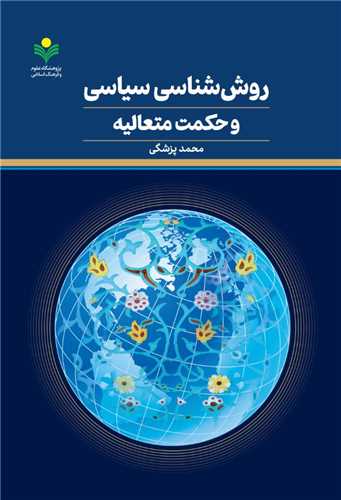
The book Political Methodology and Transcendent Philosophy, authored in Persian by Mohammad Pezeshgi, has been published in 168 pages by the Islamic Sciences and Culture Academy. Adopting a philosophical-methodological approach, this work examines the foundations for producing valid knowledge in the realm of politics, drawing upon Transcendent Philosophy to establish a robust Islamic political methodology.
According to the book’s content, its primary objective is to extract the teachings of Transcendent Philosophy relevant to the criteria of validity within political science. Within this framework, “political methodology,” as a domain of scientific knowledge, investigates the criteria and standards required for producing valid knowledge in political science.
The author explains that the validity of political research depends on a set of fundamental components. These include the methods for constructing and testing political theories, the logic governing the theorization process, the necessary criteria for a theory’s validity, the structure and format of political theories, as well as the mode of connection between theoretical frameworks and the objective issues of the research.
Emphasizing the diversity of paradigms within the humanities, the book demonstrates that each of these approaches provides distinct answers to methodological inquiries. In this context, the present work elucidates the response of Transcendent Philosophy to these issues and endeavors to re-examine the position of this school of thought within the methodological constellation of the humanities.
Based on the author’s analysis, Transcendent Philosophy exhibits fundamental differences from other prevalent paradigms in the humanities across three levels: the structure of argumentation, the genesis of political theory, and the criteria for scientific validity. These differences are regarded as the foundational basis for presenting a distinct approach to the production of political knowledge within the framework of Islamic philosophy.
This work can be considered an endeavor to formulate an Islamic political methodology grounded in the Islamic-Iranian philosophical tradition, and to redefine the criteria of scientific validity in light of the Islamic philosophical tradition.