
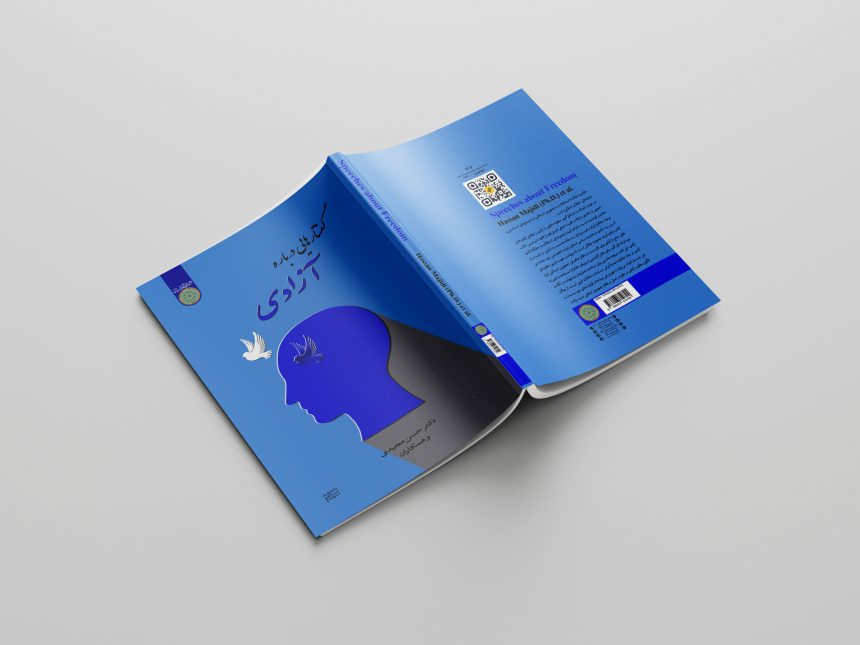
The book Speeches about Freedom, written in Persian by Hassan Majidi and his collaborators, has been published in 380 pages by Imam Sadiq University Press.
“Freedom,” alongside “independence” and the “Islamic Republic,” constitutes one of the fundamental slogans and ideals of the Islamic Revolution. With the aim of contributing to the formation of an intellectual framework for freedom and to the enhancement of public freedoms in the country—as well as strengthening and improving the implementation of Article Nine of the Iranian Constitution—the book seeks, by assembling a collection of scholarly articles, to examine the status of freedom in the thought of Iranian and Western thinkers.
The first three articles are devoted to “Freedom in the West,” while the subsequent contributions address “Freedom in Islamic and Iranian Political Thought.” The purpose of this book is to provide a collection of essays that may contribute to the development of a comprehensive theoretical system of freedom, suitable for application within the system of governance of the Islamic Republic of Iran.
For readers seeking an account of how Muslim and Western thinkers have approached the concept of freedom, this book offers an appropriate entry point for understanding the distinctions and outcomes of differing perspectives on freedom among predominantly Iranian Muslim thinkers and Western intellectuals. Through this brief inquiry, one may gain insight into some of the important contexts and capacities for achieving a desirable model of freedom, both in theory and in practice, within the system of the Islamic Republic.
The book is organized into two parts: “Freedom in Western Political Thought” and “Freedom in Islamic and Iranian Political Thought.” The first part consists of three chapters: “The Place of ‘Freedom’ in the Political Philosophy of Plato and Aristotle,” “The Transformation of the Concept of Freedom in Western Political Thought,” and “An Examination of the Distinction between Negative and Positive Freedom in Isaiah Berlin’s Thought Based on Quentin Skinner’s Hermeneutics.”
The second part of the book comprises eight chapters, namely: “Political Freedom in the Political Thought and Governing Practice of Imam ʿAli (peace be upon him),” “A Comparative Study of the Idea of Freedom in the Views of Constitutional-Era Religious Scholars and Intellectuals,” “A Comparison of the Supplementary Fundamental Laws of the Constitutional Era and the Constitution of the Islamic Republic of Iran from the Perspective of the issue of Freedom,” “Freedom in the Political Thought of the Supreme Leaders of the Islamic Revolution,” “The Relationship between Justice and Freedom: A Comparison of the Views of Martyr Morteza Motahhari and John Rawls,” “Freedom in the Views and Thought of Ayatollah Javadi Amoli,” “The Transformation of the Concept of ‘Freedom’ in the State Structure and Political System of Sunnism,” and “Freedom and Security.”
It is worth noting that Dr. Hassan Majidi is a faculty member at Imam Sadiq University. Numerous books and articles by him have been published, including The Political Rationality of al-Farabi and Thomas Aquinas and The Electoral and Party System of the Islamic Republic of Iran.