
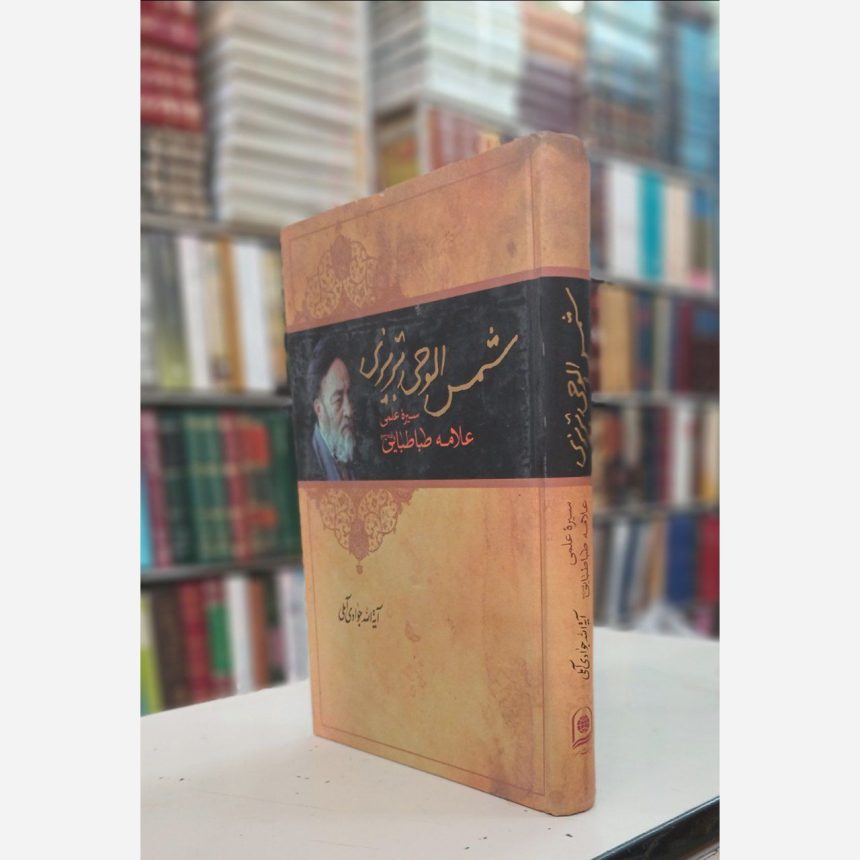

A Critical Review of the Book Shams al-Waḥy Tabrīzī: An Analysis of the Intellectual System of Allameh Tabataba’i
Introduction
1. Beyond Biography
The book Shams al-Waḥy Tabrīzī (The Sun of Revelation of Tabriz), authored by Ayatollah Abdollah Javadi Amoli, stands as a foundational and analytical text for understanding the scholarly, practical, and methodological life of Allameh Sayyid Muhammad Husayn Tabataba’i. This review aims to provide a comprehensive overview for the academic community and professors of Islamic studies by examining the structure, epistemological foundations, exegetical methodology, and the philosophical and mystical approaches presented in this work. This text seeks to transcend conventional biographies and historical accounts of an individual’s life to showcase the comprehensive scholarly foundations of Allameh Tabataba’i. In doing so, it portrays a spectrum of his thought, from the Neo-Sadrian school and the “Qur’an by the Qur’an” method of exegesis to the explication of the inseparable link between the “Qur’an, reason (burhān), and mysticism (‘irfān)” within his scholarly persona.
From the perspective of Islamic studies, Shams al-Waḥy Tabrīzī is far more than a conventional hagiography or biography. It is a “methodological analysis” of a phenomenon that can be termed “the school of Allameh Tabataba’i.”
Simultaneously, this book is not merely a dry, scholarly text. Alongside its depiction of the Allameh’s fully developed scholarly personality, it resonates with human emotion. The author explicitly states: “We have expressed our love and devotion to Allameh Tabataba’i in this book,”[1] for Allameh Tabataba’i was worthy of this reverence and affection: “…his life, in the truest sense, was the life of the Qur’an; he lived with the Qur’an, acted by the Qur’an, and spoke and wrote based on the Qur’an.”[2]
Apart from his profound intellectual devotion to the religious tradition, he possessed a necessary awareness of the views of prominent global thinkers, particularly Western intellectuals. His book The Principles of Philosophy and the Method of Realism and portions of his exegesis, Tafsīr al-Mīzān, demonstrate his relative success and efforts to engage with the Western philosophical tradition, its schools of thought, and the ideas of leading thinkers of his time. In reality, he initiated a cultural and intellectual revolution that led to the weakening, and even the dissolution, of materialism in Iran.
2. A Unique Writing Style
The text of this book, and indeed the majority of Ayatollah Javadi Amoli’s writings, is characterized by a “specialized, demonstrative, and integrative style.” It is a “precise technical prose” built upon “logical reasoning” and contains “interdisciplinary interactions,” distinguished by its “high conceptual density” and “complex literary structure.” This style, rather than being for general communication, is a highly precise instrument for conveying profound and specialized ideas to an elite, scholarly audience.
- Conceptual Density and Conciseness: This is the most prominent feature of his writing. Sentences are not often short, but even in brief sentences, a high volume of specialized concepts and terminology is embedded. He conveys maximum scholarly meaning with a minimum of words. This style compels the reader to reflect and re-read, as each word is meticulously chosen to play a key role in the argumentative structure. Consequently, speed-reading his works is largely meaningless.
- Precise and Specialized Terminology: The author adheres strictly to the semantic boundaries of words. In his texts, Arabic or Persian terms are never used synonymously or with laxity. Each term is employed precisely in its technical context within philosophy, mysticism, literature, jurisprudence, or exegesis. This feature makes the text extremely precise for specialists but difficult to access for the general reader.
- Complex Literary Structure and Interconnected Sentences: His sentences are often “complex” and “subordinate” (containing multiple dependent clauses), utilizing parenthetical phrases, numerous adverbs, and lengthy relative clauses. This syntactical structure reflects the complex structure of the thought and argumentation itself.
- Demonstrative and Inferential Style: His writing is not descriptive or narrative but is inherently demonstrative. The text is constantly arranging premises to arrive at a logical conclusion. The structure of the writing often proceeds as “thesis -> first premise -> second premise -> … -> conclusion.” For this reason, the tone of the text, despite its literary grace and beautiful cadence, is decisive and reliant on rational argumentation.
- Amalgamation and Integration of Sciences: One of the main hallmarks of his style is the unique ability to integrate the language and concepts of various Islamic sciences. In a single paragraph, he can analyze a Qur’anic verse with a proof from Sadrian philosophy, link it to an insight from theoretical mysticism, and derive a theological conclusion from it. This feature makes his texts exceedingly rich but requires the reader to be proficient in multiple fields.
1. Tabataba’i as a School of Thought
In the contemporary history of Islamic thought, few figures can be found who, like Allameh Sayyid Muhammad Husayn Tabataba’i, were able to bring together the three major currents of philosophy (Sadrian School of Transcendent Philosophy), theoretical mysticism, and revelatory exegesis into a coherent and contradiction-free system. The Islamic world’s encounter with the intellectual challenges of modernity and imported schools of thought such as materialism, Marxism, and liberalism necessitated a reconstruction of Shi’i rationality—a mission that Allameh Tabataba’i undertook in a foundational manner. In this context, understanding the dimensions of such a thinker’s personality and scholarship requires an intra-school analysis by students who have themselves reached the level of ijtihād (independent reasoning) in these sciences.
The book Shams al-Waḥy Tabrīzī is written with such an approach. The author’s intelligent and metaphorical choice of this title is inspired by the historical role of “Shams al-Ḥaqq Tabrīzī” (The Sun of Truth of Tabriz) in the formation of the mystical personality of Jalal al-Din Rumi. This naming signifies the profound student-master relationship and reflects the fact that, in the author’s eyes, Allameh Tabataba’i is like a sun that has cast the rays of revelation into the body of wisdom and mysticism, bringing about a profound transformation in his students’ understanding of the sacred texts.
2. Bibliographical Information
The book Shams al-Waḥy Tabrīzī (The Scholarly, Mystical, and Ethical Life of Allameh Tabataba’i) was penned by Ayatollah Abdollah Javadi Amoli and was first published in August 2007 with a print run of three thousand copies by the Esra Publishing Center. Owing to the distinguished scholarly status of the author on the one hand, and the importance and appeal of its subject on the other, this valuable work was able, shortly after its publication, to establish its place as one of the primary and authoritative reference sources for the scholarly understanding of Allameh Tabataba’i’s personality among seminary and academic circles.
Methodological Evaluation and Critique of the Work
It should be noted that the author’s (Ayatollah Javadi Amoli’s) approach stems from an intra-discursive perspective centered on “a specialized analysis by a student of his master.” Therefore, researchers will find this work to be more “Analytical-Descriptive” than “critical-challenging,” although the end of the book does dedicate several pages to his objections to Allameh Tabataba’i’s philosophical views. The author’s goal was not a structural critique of the Allameh’s opinions, but rather the refinement, elucidation, and decoding of the hidden foundations within his intellectual system—a mission he accomplished with unparalleled success and expertise.
3. Structural and Content Analysis of the Book’s Chapters
The book Shams al-Waḥy Tabrīzī is architecturally structured to cover the three facets of the Allameh’s scholarly personality. These facets are reflected in three main parts:
Part One: The Qur’anic Sphere, the Methodology of Revelatory Exegesis, and the Nature of the Interaction between the Qur’an and Sunnah
The first and most central part of the book is dedicated to the place of the Holy Qur’an in the Allameh’s personal and scholarly life. In this section, the author presents a faithful existence and “constant intimacy with divine revelation” as an epistemological prerequisite for entering the field of exegesis. From the book’s perspective, understanding sacred texts is not merely a linguistic operation but requires purity of the soul and a Qur’an-centric life.
Complete mastery of the Qur’anic verses, familiarity with its clear (muḥkamāt) and ambiguous (mutashābihāt) verses,[3] distinguishing concept from instance, accessing the inner meaning of verses using their apparent meaning, interpreting a verse through other Qur’anic verses, and utilizing other sciences in Qur’anic exegesis are among the most important characteristics of Allameh Tabataba’i in his interpretation of the Holy Qur’an.
What is significant, however, is the systematic comparison between Allameh Tabataba’i’s exegetical method and that of other commentators. In confronting the sacred text, exegetes have employed various tools and presuppositions. With the emergence of Tafsīr al-Mīzān, a fundamental transformation occurred in the methodology of exegesis. Recognizing the magnitude of this transformation requires a critical re-examination of previous methods and an analysis of the specific features of Allameh Tabataba’i’s exegetical school.
1. The Methodology of Previous Exegetes: An Atomistic Approach and Reliance on Extra-Textual Tools
An examination of the dominant practice among previous exegetes reveals the prevalence of an “atomistic” view of the Qur’anic verses. The main features of this method include:
- Primacy of Linguistic and Literary Tools: In this school, the main burden of understanding the text rests on dictionaries, lexicons, and the rules of Arabic sciences (morphology, syntax, eloquence, rhetoric, figurative language, and metaphor). The exegete, in this method, approaches the text like a literary scholar.
- Use of Frameworks from the Science of Uṣūl: To resolve apparent contradictions or ambiguities in the verses, previous exegetes often utilized rules from the principles of Islamic jurisprudence (uṣūl al-fiqh), such as “general and specific” (‘āmm wa khāṣṣ), “absolute and restricted” (muṭlaq wa muqayyad), and “abrogating and abrogated” (nāsikh wa mansūkh), analyzing verses within these pre-established frameworks.
- Reducing Qur’an-by-Qur’an Exegesis to Lexical Comparison: Although the claim of interpreting verses with other verses was made in the past, this cross-referencing often remained at the lexical level. An exegete, upon seeing a word in one verse, would search for and gather its similar instances throughout the Qur’an, which did not necessarily lead to the discovery of deeper layers of meaning.
2. The Innovation of Allameh Tabataba’i’s Exegetical School: A Structural and Foundational Approach
In his engagement with the Divine Word, Allameh Tabataba’i established a completely distinct and “intra-textual” method based on a holistic view of the Qur’an’s geometric structure:
- The Inadequacy of Human Language to Reflect Revelatory Truths: The Allameh’s epistemological premise is that vocabulary and literary rules are only useful for understanding the exoteric aspects and lack the capacity to convey the unseen realities and sublime teachings of the Qur’an. Therefore, the exegete must move beyond the platform of lexicology to reach the depths of the Qur’an’s own semantic network.
- Theory of Foundational (Root) and Superstructural (Branch) Verses: The Allameh’s fundamental innovation was the methodological distinction of verses into two categories: “foundational” and “branch.” He believed the Qur’an is a tree-like structure whose roots (key verses) are the keys to understanding concepts and opening closed doors of meaning (abwāb). Superstructural verses must necessarily draw their intellectual nourishment from these foundational verses.
- Organic (Living) Interpretation of Verses: In this approach, instead of referring ambiguities to the rigid rules of uṣūl, ambiguous verses are directly referred to their foundational counterparts within the Qur’an itself. For example, in interpreting the concept of “the path of those upon whom You have bestowed favor” (ṣirāṭa alladhīna an‘amta ‘alayhim) in Surat al-Fatihah, instead of engaging in purely linguistic discussions, the Allameh refers to verse 69 of Surah Al-Nisa,[4] which clearly explains the instances and foundation of the recipients of divine favor.
3. Allameh Tabataba’i’s Theory: A Metaphysical Approach and Inner Witnessing
Rejecting the reductionist approach of previous exegetes, Allameh Tabataba’i offers a deeper interpretation. The pillars of his theory are:
- Witnessing in the Celestial Realm (‘Ālam al-Malakūt): In addition to their worldly lives, human beings have a dimension and abode in the realm of malakūt. In that state of being, man directly witnesses and observes his own intrinsic poverty and the unity of the Lord with his entire being and with the “eye of the heart.”
- The Reality of Dialogue, Not Merely an Expression of State: The Allameh insists that this dialogue (the question and answer in the Verse of the Covenant) is a “real dialogue” and not just a figurative expression of state. This inner witnessing of the Truth signifies the very primordial covenant of man with God.
Therefore, Allameh Tabataba’i states that exegetes who have not properly understood the language of the Qur’an have conflated the boundaries between “exegesis” (tafsīr) and “allegory” (tamthīl). In his belief, the failure to recognize the proper place of allegory has caused these commentators to empty the verse of its ontological reality and existential history, reducing it to a merely literary and figurative proposition.
For instance, verse 172 of Surah Al-A’raf, known as the ‘Verse of Particles’ (Āyat al-Dharr) or the ‘Covenant of Alast’ (Peymān-i Alast) (wa idh akhadha rabbuka min banī ādama…),[5] has always been one of the most challenging verses among exegetes. The main point of contention is how to analyze and understand the nature of the dialogue between God and human beings—specifically, the divine inquiry “Am I not your Lord?” (alastu bi-rabbikum, the phrase from which the name ‘Alast’ is derived) and the human response “Yes, we testify” (balā shahidnā)—as well as the time and place of this covenant’s occurrence.
Many classical exegetes (like al-Baydawi) and philosophers such as Muhaqqiq al-Damad resorted to the tool of “allegory” (tamthīl) to resolve the complexities of this verse. From their perspective, the dialogue mentioned in the verse is not a real, objective event but merely a form of “expression of state” (zabān-i ḥāl) and a metaphorical statement. The verse’s purpose, in their view, is to state that God, by presenting ontological and rational proofs, has, as it were, elicited a confession of His Lordship from human beings.
Furthermore, the complex topic of “tafsīr (exegesis) and ta’wīl (hermeneutic interpretation)” is meticulously examined in this section. The author, with academic precision, delineates the boundaries between the exoteric interpretation and the esoteric realities of the Qur’an from the Allameh’s viewpoint, showing that ta’wīl in Tabataba’i’s thought, unlike extremist esoteric approaches, is not an abandonment of the text’s literal meaning but rather the tracing of the discourse back to an objective, external reality from which the text originates.
4. Harmony between the Qur’an and the Infallible Imam (a.s.)
According to the famous Hadith of the Two Weighty Things (Ḥadīth al-Thaqalayn),[6] the Prophet’s household (Ahl al-Bayt) are the co-equal and counterpart of the Qur’an. This means that if the Qur’an were to take on a human form, it would be the Infallible Imam (a.s.), and if the Infallible Imam (a.s.) were to be compiled in written form, it would manifest in the form the Holy Qur’an.
Therefore, the narration of an Infallible (a.s.) will in no way contradict the Qur’an. The four-stage systematic interaction with narrations is established for this very purpose:
The Four-Stage Systematic Interaction with Narrations:
In the Allameh’s view, the bond between the Qur’an and the Sunnah was considered deep and unbreakable. To allow narrations into the domain of exegesis, he presented a precise, four-stage methodology in accordance with his narrative framework:
- Stage One (Primacy of Inquiry from the Qur’an): Before consulting narrations, one must turn to the Qur’an, because without understanding the Qur’an’s general framework and constitution, one cannot properly benefit from narrations, and narrations do not have absolute independence from the Qur’an.
- Stage Two (Presentation to the Qur’an): Since the issuance of all hadiths is not definitive, presenting them to the text of the Qur’an (evaluating them against the text of the Qur’an) is a necessary and unavoidable step.
- Stage Three (Purification and Conflict Resolution): Evaluating hadiths in light of the Qur’an’s general principles. This means that narrations contradicting the Qur’an are set aside, and internal contradictions among accepted narrations are resolved using jurisprudential principles (such as explicit text versus apparent meaning).
- Stage Four (Specification and Restriction): After completing the above stages, the outcome and product of the narrations are again presented to the Qur’an to specify its generalities (takhṣīṣ) or restrict its absolutes (taqyīd).
5. Epistemological Status of Hadith Compilations
Despite giving centrality to the Qur’an, Allameh Tabataba’i held deep respect for Shi’i hadith sources. He did not consider books like Allameh Majlisi’s Biḥār al-Anwār (especially the volumes related to monotheism, justice, and the afterlife) to be mere collections of quotations, but rather vast treasures of revelatory sciences that require teaching, commentary, elucidation, and precise rational and theological analysis. Hence, out of deep conviction, he would also kiss and show reverence for books of hadith, just as he would for the Qur’an.
6. Situating al-Mīzān within the Islamic Epistemic System
The book Tafsīr al-Mīzān, Allameh Sayyid Muhammad Husayn Tabataba’i’s most important Qur’anic work, holds a very special significance not only among Shi’is but also in the view of non-Shi’i and even non-Islamic thinkers (Orientalists and Western scholars of Islam). The writing of Tafsīr al-Mīzān was the result of a gradual and interactive process. The initial nucleus of this exegesis was written during the Allameh’s stay in Tabriz amidst the scholarly limitations of that era. However, his move to the seminary of Qom and the formation of question-and-answer sessions and scholarly critiques with his students provided a platform to rectify its initial shortcomings (including excessive brevity and its restriction to certain parts of the Qur’an), allowing the work to mature and reach completion as a twenty-volume exegetical encyclopedia.
The reasons for its importance can be briefly summarized as follows:
- Epistemic Origin; The Integration of Reason and Mysticism (Sacred Effusion):
The secret to the profound nature of Allameh Tabatabai’s thought and his unparalleled innovations must be sought in this very epistemological foundation: a nexus where intellect (rational demonstration) and intuition (mysticism) converge in the light of revelation, yielding fruits akin to “sacred effusion” (fayd-i qudsi). It is precisely by virtue of this comprehensiveness and auspicious synthesis that his intellectual contributions transcend his own era. This is true to such an extent that prominent figures like Morteza Motahhari (who had a deep scholarly and intellectual connection with the Allameh) used to say, “Understanding the words of the Allameh will be possible for thinkers in one or two hundred years.” He further added, “I do not believe a book of such magnitude as Tafsir al-Mizan has ever been authored in Shi’ism.”[7]
Furthermore, one of the maraji’ (religious authorities) contemporary with Allamah frequently noted that his comprehensive mastery in the fields of philosophy, jurisprudence, and Quranic exegesis was unparalleled: “Mr. Tabatabai is a complete human being, and the views he has posited in exegesis, philosophy, and other disciplines are the product of his own original thought. I know his teachers well; although they are counted among the great scholars of Najaf, they did not possess such perspectives.”[8]
- Filling a Historical Void and Reviving Shi’i Scholarly Authority:
Ayatollah Javadi Amoli, in his pathology of the history of Shi’i exegesis, points to the historical marginalization of the Shi’a. Before the compilation of al-Mīzān, Shi’i exegeses (despite the value of works like Majma’ al-Bayān or Fayd Kashani’s Tafsīr al-Ṣāfī) had lagged behind in presenting novel and influential material in competition with Sunni exegeses (such as Alusi’s tafsīr). After a vacuum of approximately 400 years, al-Mīzān was able to break this isolation, prove the scholarly greatness of Shi’ism in the realm of Qur’anic studies, and invalidate reductionist views of Shi’i exegetical knowledge. The merit of al-Mīzān was not confined to Shi’i circles but also found its way into Sunni academic forums. The entry of this work into institutions like Dār al-Taqrīb (Center for the Rapprochement of Islamic Schools of Thought) in Egypt caused a shift in biased perspectives that previously did not grant exegetical standing to Iranian and Shi’i scholars, leading scholars from across the Islamic world to write approbations for this scholarly masterpiece.
Part Two: The Rational Sciences, the Revival of Philosophy, and Theological Innovations
The second part of the book examines the Allameh’s historical role in the field of the rational sciences and his philosophical approach. Here, the author presents Allameh Tabataba’i not only as an exegete but also as a philosopher and a reviver of theology. The Allameh’s rational approach to solving complex theological problems and his demonstrative defense of religious propositions are among the most important topics in this section.
Entering the domain of “rational innovations,” the book addresses one of the Allameh’s most significant philosophical achievements: the theory of “constructed perceptions” (idrākāt i‘tibārīyyah). This theory, which created a fundamental shift in Islamic epistemology and moral philosophy, shows how the human mind “posits” or “considers” concepts like “obligation,” “ownership,” and “leadership” to meet its social and practical needs. The author demonstrates that by precisely distinguishing between “real perceptions” (idrākāt ḥaqīqiyyah), which deal with external reality, and “constructed perceptions,” which are born of social interactions and imperatives, the Allameh was able to provide a well-reasoned response to many modern epistemological challenges. Furthermore, the Allameh’s scholarly efforts and struggles in training a new generation of distinguished students and promoting philosophy during a time when philosophizing faced resistance in the seminaries are detailed in this section.
Allameh Tabataba’i’s Methodology in Teaching and Composing Scholarly Works
1. A Structural Model in Teaching and Writing: “Mathematical and Geometric Order”
In designing his curriculum and writing his books, Allameh Tabataba’i followed a precise model similar to mathematics and geometry. The basis of this pedagogical method was that since the universe possesses a precise structure and geometry, the structure of education and the composition of books that explain this universe (such as philosophical texts) must also reflect that same ontological order. In this method, each lesson or chapter is precisely the “complement to the previous topic” and the “groundwork for the next topic,” with no pedagogical leaps or discontinuities. A clear example of this method can be seen in the noble books Bidāyat al-Ḥikmah and Nihāyat al-Ḥikmah.
2. Pedagogical Principles and Standards
As a teacher and author, he adhered to strict principles to prevent the student’s mind from becoming disorganized:
- Prohibition of Prematurely Introducing Topics: Introducing a problem before its logical turn in the course of study was, in his view, akin to “picking an unripe fruit,” which would lead to misunderstanding on the part of the reader or student.
- Exclusive Reliance on Taught Material: In presenting arguments, the teacher or author is only permitted to use self-evident truths or principles that have been proven in previous chapters or sessions.
- Avoidance of Deferral to the Future: The Allameh was strongly against asking a student to accept a premise on faith in the current session with the promise that it would be proven in the future.
3. Content Engineering and Chapterization (Tabwīb)
To prevent the intermingling of topics in the reader’s mind, the Allameh structured his books and lessons with precise demarcations:
- Section on General Discussions: Chapters dedicated to universal and comprehensive principles (where the subject and predicate are coextensive, such as the primacy of existence).
- Section on Specific and Divisional Discussions: Chapters that dealt with more particular branches and divisions (such as cause and effect, or mental existence).
He did not allow the topics of these two sections to be mixed during teaching or within the book’s chapters.
4. Innovation in Pedagogical Arrangement Compared to Predecessors
Adherence to this method of composition caused the structure of the Allameh’s educational books to differ significantly from the works of his predecessors. For example, Bidāyat al-Ḥikmah and Nihāyat al-Ḥikmah are different in this regard from books like Mulla Sadra’s Asfār or Sabzawari’s Manẓūmah. Two noteworthy examples are:
- Changing the Position of the Topic of “Making” (Ja‘l): While his predecessors had opened a separate chapter for this discussion in their books, the Allameh, in his compositions, removed its independent status and placed it as a subsection under the chapter on “Cause and Effect.” This is because, from a pedagogical standpoint, until the law of causality is proven, discussing what a cause gives to its effect (ja‘l) is meaningless.
- Precise Placement of Complex Topics: He discussed and resolved the difficult issue of “the union of the knower and the known” (ittiḥād al-‘ālim wa al-ma‘lūm) exactly in its proper pedagogical place, avoiding scattered references in other chapters of the book.
Part Three: The Spiritual Path and the Mystical School
In the realm of “theoretical and practical mysticism,” the Allameh’s views on issues such as “the personal unity of being” (waḥdat al-wujūd al-shakhṣiyyah), “the reality of ontological and legislative guardianship” (wilāyah takwīniyyah wa tashrī‘iyyah), and “traversing the stages and stations of human perfection” are explored. The author explains that Allameh Tabataba’i understood mysticism not as isolationism or baseless ecstatic utterances, but as the inner dimension of the Shari’ah and the ultimate goal of the human rational path.
The book’s most significant analytical achievement is proving the claim that Allameh Tabataba’i attained the high station of “comprehensiveness”. Throughout the history of Islamic thought, there have always been historical conflicts between philosophers (the people of reason), mystics (the people of intuition), and theologians/exegetes (the people of transmitted knowledge). The book explains well that in the Allameh’s intellectual paradigm, well-founded rational findings, intuitions of the heart and mystical unveilings, and the teachings of revelation are not only free from conflict and contradiction but are mutually supportive and complementary. Truth is one, and these three instruments are merely different paths to attain that one truth. This intellectual comprehensiveness was tangibly present and manifest in his practical character.
The final part of the book addresses the most subtle and perhaps most difficult-to-grasp aspect of Allameh Tabataba’i’s personality: his practical and theoretical mysticism. Under the title “Mystical and Ethical Life,” the author describes the practical conduct of his master, which was filled with asceticism, humility, silence, and profound spiritual states. These descriptions are not merely ethical; they demonstrate the practical realization of abstract mystical concepts in the life of a divine sage. Considering Allameh Tabataba’i’s comprehensive personality, his ethics and divine conduct were part of his scholarly persona; his very existence was a refutation of the principle of the separation of value from knowledge. Ayatollah Javadi Amoli, who accompanied him for many years, describes the Allameh’s most important ethical characteristics as follows:
1. Commitment to Spirituality and Worship:
Throughout his life, Allameh Tabataba’i was intimate with wakefulness and worship in the pre-dawn hours, spending those moments in prayer and communion. His tears and worship were not limited to these hours, though; while reciting and interpreting the Qur’an, upon reaching verses of mercy, wrath, repentance, etc., he would be moved and would sometimes weep.
2. Acting upon Knowledge:
The fruit of knowledge is greater humility and submission before God and His creation. The signs of divine mercy were evident in this man, for his knowledge did not lead to arrogance. He had no love for leadership and actively fled from it; he held the love of God and His sincere servants in his heart.
3. Qur’anic Ethics:
Just as it is narrated that the character of the Messenger of Allah (peace be upon him and his progeny) was the Qur’an,[9] Allameh Tabataba’i was also, in his own right, a refined individual who possessed justice, piety, humility, courtesy, asceticism, benevolence, contentment, purity, compassion, and other Qur’anic attributes. He had lived a lifetime in the presence of the Qur’an, and accordingly, the Glorious Qur’an was clearly manifest in his life’s conduct.
It is narrated that “the Messenger of God (peace be upon him and his progeny) said: The disciples said to Jesus, ‘O Spirit of God, with whom should we sit?’ He said: ‘One whose sight reminds you of God, whose speech increases your knowledge, and whose actions make you desire the Hereafter.’” The Allameh’s calm, ascetic, and contemplative countenance was a clear instance of a sight that involuntarily reminded his companions of God (“whose sight reminds you of God”). This principle was observed in the Allameh’s being.
The Allameh’s comprehensive personality, in its unique integration of knowledge, mysticism, and practice, had made him the living embodiment of this narration for seekers of truth (“whose sight reminds you of God”).
His firm logic and scholarly discourse in teaching Tafsīr al-Mīzān and philosophy continuously expanded the horizons of his students’ knowledge and understanding (“whose speech increases your knowledge”).
His humble lifestyle, disregard for worldly trappings, night vigils, and sincere deeds awakened in hearts the longing to attain otherworldly perfections (“whose actions make you desire the Hereafter”).
4. Open-mindedness in Scholarly Debates:
During one summer when the Allameh was staying in the Darakeh area of Tehran, a highly educated and prominent leader of the Tudeh (Communist) Party, who had completed his medical studies in France, came to meet him for a debate. This conversation began in the afternoon and lasted for about eight hours, until late into the night.
The central axis of this lengthy debate was the intellectual foundations of dialectical materialism and the proofs for the existence of God. Allameh Tabataba’i, with exemplary patience, forbearance, and calmness, responded to all the doubts and questions of the Marxist doctor and challenged his intellectual foundations with firm logic.
At the end of these eight hours, the Marxist doctor, who was deeply impressed by the depth of the Allameh’s knowledge and the power of his reasoning, admitted that all his intellectual and ideological foundations had crumbled. He later said, “Mr. Tabataba’i made me a monotheist.”[10]
5. Humility:
One of his most prominent ethical and scholarly traits was the courage and frankness to say, “I do not know,” in response to a question to which he did not have a definitive answer. This behavior was not considered a sign of scholarly weakness but was a testament to his supreme piety, scholarly integrity, and unparalleled humility. His humility was even more manifest before his students, whom he regarded as his own children and treated with dignity.
Conclusion
In any case, a review of Shams al-Waḥy Tabrīzī reveals it to be a profound and authoritative work emphasizing the inseparable link between the “Qur’an, reason, and mysticism” in contemporary Shi’i thought. With a sophisticated prose and a methodical structure, this work shows its academic and seminary audience how Allameh Tabataba’i, by simultaneously employing “demonstrative reason in the speculative sphere” and “mystical intuition in the practical sphere,” opened a new and solid path in the interpretation of sacred divine texts—a path whose lofty peak is manifested in the book Tafsīr al-Mīzān.
For professors of Islamic studies, researchers in the philosophy of religion, and students of theology, studying and analyzing this book is not merely a review of a thinker’s life history. It is a means of accessing the keywords and foundations of the intellectual system of a divine sage who was able to redefine and fortify the boundaries between tradition and modernity, and religion and philosophy, without deviating from revelatory principles. In this respect, the inclusion of this book in the graduate curriculum for the fields of Qur’anic and Hadith Sciences, Islamic Philosophy, and Islamic Mysticism is deemed essential and illuminating.
In the international context, it is strongly recommended that, due to its specialized language and highly scholarly expression which has practically limited the book’s audience to a small number of specialists in Islamic sciences, the language first be simplified before this weighty work is translated. The content of this book, if simplified, could serve as an intellectual manifesto for the young academic and seminary generation in understanding the school of the Allameh.
Additionally, in cases where Allameh Tabataba’i’s innovations are discussed, more reasoning and proof should be added. To address the lack of comparative analysis with other exegetes, other counterparts from both the cultural East and West should also be included.
- Javadi Amoli, Abdullah, Shams al-Waḥy Tabrīzī, p. 12. ↑
- Ibid., p. 45. ↑
- Muḥkam (decisive/unequivocal) and mutashābih (allegorical/ambiguous) are two technical terms in Quranic sciences derived from verse 7 of Surah Al-‘Imran. Muḥkam refers to a firm and lucid discourse that leaves no room for ambiguity or misinterpretation. In contrast, mutashābih denotes a statement that, standing alone, appears inadequate and ambiguous, making it susceptible to multiple interpretations. Various perspectives have been proposed regarding how to interpret mutashābih verses: some exegetes maintain that mutashābih verses can be interpreted and hermeneutically resolved (taʾwīl) by referring them back to the muḥkam verses, asserting that the definitive knowledge of the mutashābihāt is exclusive to God and “those firmly grounded in knowledge” (al-rāsikhūna fī al-ʿilm). ↑
- “And whoever obeys Allah and the Messenger – those will be with the ones upon whom Allah has bestowed favor of the prophets, the steadfast affirmers of truth, the martyrs and the righteous.” (Qur’an 4:69). ↑
- “And [mention] when your Lord took from the children of Adam – from their loins – their descendants and made them testify of themselves, [saying to them], ‘Am I not your Lord?’ They said, ‘Yes, we testify.’” (Qur’an 7:172). ↑
- The Holy Prophet (peace be upon him and his progeny), as a perpetual testament to his community, said: “Verily, I am leaving among you two weighty things (al-thaqalayn): the Book of God and my progeny (itratī), my Ahl al-Bayt. They shall never separate from each other until they meet me at the Pool (al-ḥawḍ). As long as you hold fast to them, you will never go astray nor will you falter.” (Sources: Ṣaḥīḥ al-Tirmidhī, Hadith 3786; al-Uṣūl min al-Kāfī, Kitāb al-Ḥujjah, Bāb al-Ishārah wa al-Naṣṣ ʿalā Amīr al-Mu’minīn (a.s.), vol. 1, p. 294, Hadith 3). ↑
- Motahhari, Morteza, Iḥyā-ye Tafakkor-e Eslāmī (The Revival of Islamic Thought), p. 24. ↑
- Shams al-Waḥy Tabrīzī, p. 159. ↑
- Musnad Aḥmad ibn Ḥanbal, vol. 6, p. 91, Hadith 163. ↑
- Shams al-Waḥy Tabrīzī, p. 241. ↑