
“There is so much being written today that concerns the social, political and economic aspects of Islam, to the extent that the spiritual teachings at the heart of the Islamic tradition is often forgotten. The present book renders a great service in pointing to the centrality of the inner dimension of Islam and the pertinence of its teachings for the world today.”
— Seyyed Hossein Nasr
University Professor of Islamic Studies, The George Washington University

Introduction to Islam Within
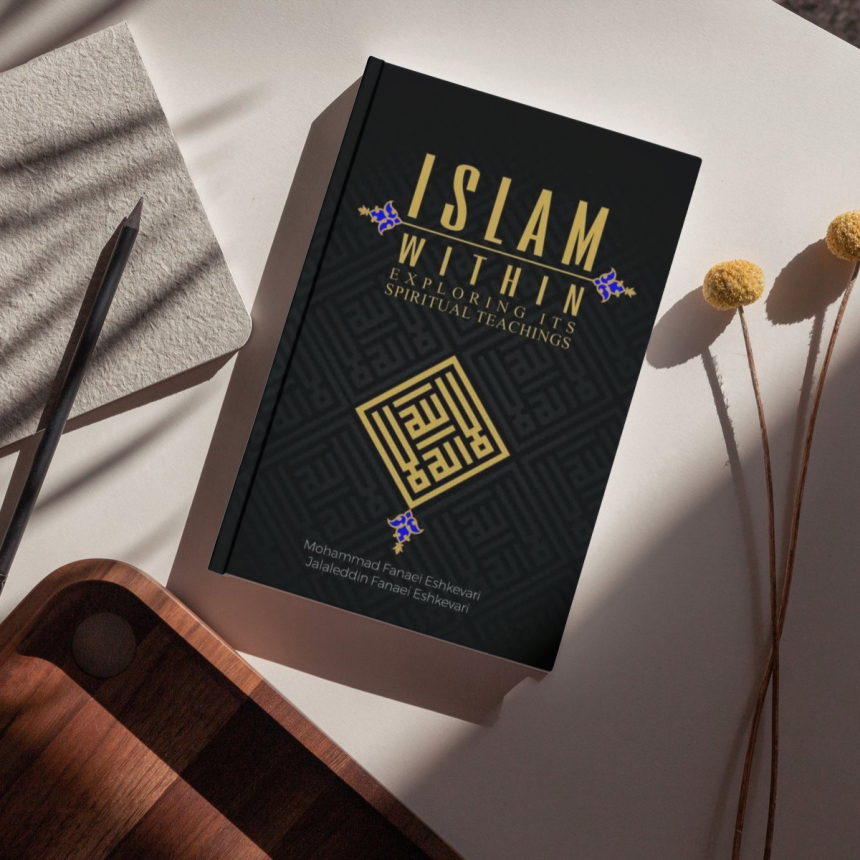
Mysticism has always occupied an uneasy place within Islamic thought — venerated as its spiritual core, yet often mistrusted as its deviation. Islam Within: Exploring Its Spiritual Teachings, authored by Mohammad Fanaei Eshkevari and Jalaleddin Fanaei Eshkevari, enters this long-standing debate with both scholarly precision and spiritual conviction. The book argues that ‘irfan (Islamic gnosis or mysticism) is not a marginal phenomenon but the inward essence of Islam itself. It aims to show that intellect, revelation, and mystical intuition are not competing routes to truth, but dimensions of a single divine reality.
From the outset, the work distinguishes itself by its composure and clarity. The authors write not to mystify but to elucidate. Their preface situates the reader amid timeless existential questions — Who am I? What is my purpose? — and then proposes that the answers lie in Islam’s inner wisdom. This intellectual and devotional tone sets the book apart from both academic detachment and popular piety. It seeks to reclaim spirituality as a rigorous discipline, not an emotional escape.
The Conceptual Framework of Islam Within
The early chapters provide a carefully structured introduction to Islamic mysticism’s key concepts. The distinction between ‘irfan and tasawwuf is drawn with unusual precision: while tasawwuf derives from the woolen cloak of early ascetics, ‘irfan originates in Qur’anic vocabulary of knowledge and recognition. By favoring ‘irfan, the authors align their study with a scriptural and philosophical lineage rather than with the historical and sometimes controversial Sufi orders. The result is a conceptual framework that is both linguistically accurate and theologically grounded.
Harmony and Tension in Islam Within
Yet this clarity also reveals the book’s most persistent tension. The authors explicitly state their thesis that “mysticism is not against religion, not independent of religion, not identical to religion, and not a part of religion’s components, but mysticism is the inner dimension of religion”. This view presupposes perfect harmony between Shari‘a, theology, and spiritual experience. That harmony is intellectually elegant but historically fragile. Figures such as Hallaj, Suhrawardi, and Ibn Arabi lived — and often died — within the friction between revelation and inspiration. By smoothing these conflicts into synthesis, the book risks idealizing what was, for many mystics, a life of paradox and peril. Perhaps this focus on synthesis arises from the authors’ aim to present the ideal integration sought within the tradition, prioritizing the underlying spiritual coherence over recounting every historical complexity. Islam Within seeks to introduce readers to the spiritual coherence of the Islamic tradition rather than to reenact its internal struggles. A more dialectical treatment of those tensions, however, might have given the argument greater historical and emotional depth.
A similar serenity characterizes the discussion of reason and revelation. The authors argue persuasively that intellect (‘aql) and intuition (kashf) are complementary faculties: reason prepares the ground for divine illumination and later interprets what the heart perceives. This vision restores to mysticism its rational dignity and effectively challenges the stereotype that spirituality opposes thought. Still, the portrayal is perhaps too harmonious. Many mystical traditions, even within Islam, describe the meeting of intellect and revelation as a site of crisis — where logic falters and insight dawns through unknowing. Islam Within largely sidesteps this drama. Its balance is admirable, but its serenity can feel slightly insulated from the existential turbulence that historically fueled the formative debates that distinguished one mystical school from another.
Language and Epistemology in Islam Within
The book’s prose reflects the same calm discipline. It is fluent, methodical, and accessible — a significant achievement in a field prone to obscurity. The language conveys respect for the reader’s intellect, free of jargon and polemic. Yet the very equilibrium that makes the text readable also reduces its emotional texture. Mysticism, after all, is born in intensity and paradox; its truths are often conveyed through symbolic shock rather than systematic clarity. The authors’ didactic tone offers coherence but not always vitality. Their intention is to teach rather than to transport, to instruct more than to ignite — a choice that lends the work authority but limits its imaginative reach.

The discussion of mystical epistemology is among the book’s strongest sections. The authors skillfully show that ‘irfan represents not irrational sentiment but a disciplined form of knowing, one that complements rather than contradicts rational and scriptural knowledge. This balanced perspective restores intellectual dignity to spirituality, challenging both Western academic reductionism and internal Islamic suspicion. The argument succeeds precisely because it is moderate: mystical intuition, they suggest, extends human cognition rather than undermining it.
Where the book becomes more interpretive — particularly in its reflections on language and poetry — the analysis is certainly engaging, though perhaps leaves room for further exploration. The authors rightly recognize that mystical truths, being inexpressible, find their most natural medium in metaphor and verse. Their discussions of Rumi, Attar, and Hafez effectively touch upon the profound interplay between aesthetic form and spiritual insight. While these examples aptly serve as illustrations of mystical ideas, an opportunity exists to delve deeper into poetry’s role as a creative force that can reshape those ideas. A more extensive engagement with the literary imagination — exploring how poetry might alter theology rather than merely echoing it — could have offered an additional layer of richness to this section.
Islam Within and the Modern World
In its final chapters, Islam Within thoughtfully extends its reach toward the modern world, weaving mystical thought into discussions of ecology, global peace, and ethical renewal. These passages are admirable in intent, positioning spirituality as a mode of engagement rather than withdrawal. While they effectively introduce important connections, the exploration feels introductory rather than exhaustive. The authors raise crucial questions about the moral and environmental responsibilities of spiritual consciousness but perhaps focus more on opening avenues than providing in-depth analysis. Consequently, readers interested in how ‘irfan might engage deeply with modern philosophy, comparative religion, or the sciences may find this section serves more as a starting point than a comprehensive dialogue.
This methodological approach is also evident in the book’s engagement with Western thought. Commendably avoiding insularity, the authors enter into a direct and thoughtful dialogue with contemporary theories of mysticism, particularly in the chapter on “Religious Experience”. Thinkers from Schleiermacher to William Alston and Steven Katz are addressed, though the engagement trends more towards comparison than synthesis. The authors skillfully use these Western philosophical frameworks to highlight the distinct position of the Islamic tradition, where personal experience serves to deepen faith rather than constitute its foundation. Consequently, Islam Within effectively presents the tradition defining itself with precision against global intellectual currents, rather than simply reaffirming heritage. While this confident self-articulation is a notable strength, readers seeking a more interwoven, cross-disciplinary theory of mysticism might observe that potential avenues for deeper synthesis remain largely unexplored.
Conclusion: The Value of Islam Within
Despite these reservations, the book accomplishes a difficult task: it makes the intricate world of Islamic mysticism accessible without trivializing it. Its conceptual coherence, restrained style, and pedagogical sensibility make it highly suitable both for general readers seeking orientation and for students needing a reliable introduction. Yet, its value extends beyond introductory purposes; even specialists will recognize and appreciate the text’s distilled synthesis of Shi‘i and Persian thought, rendered with notable clarity and sincerity.
If there is a paradox at the heart of Islam Within, it is that a book about the dissolution of the self is itself remarkably self-controlled. It describes the path of spiritual annihilation with intellectual composure, as if to prove that the life of the mind can coexist with the life of the spirit. Whether that composure is a limitation or a virtue depends on the reader’s expectation. For some, it will seem overly polished; for others, it will demonstrate the poise of a tradition confident in its own depth.
In the end, Islam Within: Exploring Its Spiritual Teachings offers more than a survey of mysticism. It presents an interpretive lens through which to view Islam as a living spiritual philosophy — rational, ethical, and contemplative. It may idealize harmony where history reveals conflict, and it may gesture toward modernity without fully inhabiting it, but its calm insistence on integration feels refreshing in an era of fragmentation. The book invites readers not to agree but to reflect, not to adopt mysticism as doctrine but to perceive it as Islam’s interior rhythm.
Measured, articulate, and quietly provocative, Islam Within reminds us that faith and reason, revelation and reflection, are not competing lights but facets of the same illumination. In recovering that vision, the authors contribute not just to the study of Islamic mysticism but to the broader conversation on how human beings continue to seek meaning in a world increasingly estranged from the sacred.





Great content! Keep up the good work!