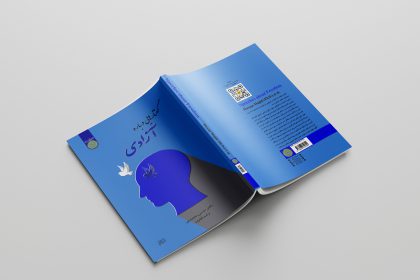


In today’s complex world, where diverse and sometimes contradictory interpretations of religious texts direct intellectual and political currents, Mohammad Abedi’s book, Pathology of Political Interpretations of the Quran, emerges as an illuminating beacon in the realm of religious understanding. This valuable work is not an ordinary exegetical book, but rather a foundational and systematic research endeavor. Employing a critical and pathological approach, it engages in a methodical and rule-based analysis of the Holy Quran within the political sphere, meticulously delineating the boundaries between sound deductive understandings and hasty, unprincipled hermeneutic interpretations.
The book emphasizes the key principle that any interpretation of Quranic verses is tantamount to attributing that understanding to the Sacred Essence of God; therefore, it entails a heavy responsibility and demands exemplary precision. By noting that while many scholars and exegetes throughout history have observed these rules, we have concurrently witnessed unprincipled and sometimes biased interpretations by various individuals and groups in the past and present, the esteemed author further elucidates the urgent necessity of addressing this subject.
This work was written with the objective of providing a “pathological perspective” to serve as a guarantor for the validity of political interpretations derived from the Quran. The structure of the book is designed across three fundamental, interconnected chapters. The first chapter addresses the pathologies arising from the failure to observe literary rules and the accurate comprehension of vocabulary, positing that any interpretation must first pass through the gateway of a precise understanding of terminology and the structural nuances of the Arabic language. The second chapter examines the application of exegetical rules related to verbal contexts, encompassing both continuous contexts (the linguistic flow of verses and chapters) and discontinuous contexts (similar verses located in other sections of the Quran). Finally, the third chapter delves into the central core of the discussion: the rules pertaining to continuous and discontinuous non-verbal contexts. This section focuses on the proper utilization of the occasions of revelation, historical data, authentic traditions, as well as the socio-political conditions of both the era of revelation and the time of interpretation. It meticulously scrutinizes the academic pitfalls of introducing political presuppositions without grounding them in these contextual indicators.
The present volume, comprising 422 pages, has been published by the Publishing Organization of the Research Institute for Islamic Culture and Thought (IICT).