
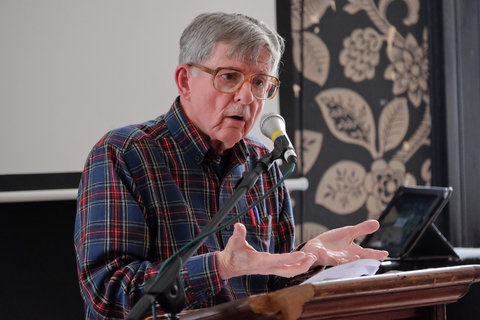

Weak Theology is one of the most distinctive currents in contemporary post-metaphysical theology. It is particularly associated with the work of the American philosopher and theologian John D. Caputo, whose project seeks to rethink God, divine power, and religious faith in the aftermath of the postmodern critique of metaphysics. Drawing heavily on Jacques Derrida’s philosophy of deconstruction, Caputo challenges what he regards as the “onto-theological” tendency of traditional theology and attempts to move beyond the conception of God as a supreme being endowed with absolute power.
At the heart of this project is a shift from “existence” to “event.” Rather than conceiving God as an objective metaphysical being who intervenes in the world, Caputo speaks of an “event” that calls for justice, love, forgiveness, and responsibility. God, in this framework, does not so much exist as insist.
There is something philosophically significant in this attempt to free theology from crude forms of metaphysical objectification and from reducing God to one being among others. Yet from the standpoint of religious realism, a fundamental question remains: Does criticizing an inadequate conception of God require abandoning the independent reality of God Himself?
The answer, from the perspective of classical and realist theology, should be no. God need not be conceived as a being alongside other beings in order to be affirmed as a reality independent of human consciousness, language, and action. The rejection of simplistic metaphysical representations of God does not, by itself, entail the rejection of divine reality.
Caputo regards significant strands of traditional theology as caught within an onto-theological framework: a framework in which God is treated as the highest being or as the first cause within a metaphysical system. In such a model, God functions as a foundational entity upon which the intelligibility of reality, morality, and religious claims can supposedly be secured.
Drawing on Derrida’s deconstructive philosophy and on Pauline themes such as the “weakness of God” and the “foolishness of the cross,” Caputo develops a different theological vocabulary. Divine power is no longer understood primarily as the capacity to impose an external will upon the world. Instead, the divine is associated with weakness, unconditionality, and the call to justice, compassion, forgiveness, and responsibility.
This move raises a fundamental question: Does the rejection of God as an objectifiable metaphysical entity entail the rejection of God as an independently existing reality?
Classical theology has never required that God be understood as a being in the same sense as created beings. To say that God is not one entity among others is not to say that God is unreal. Indeed, the distinction between God as a being among beings and God as the transcendent source of being is fundamental to much of the classical theological tradition.
From this perspective, the critique of onto-theology does not necessarily lead to theological anti-realism. One may reject a naïve metaphysical picture of God while maintaining that God is objectively real.
One of the central ideas in Caputo’s theology is the distinction between the “name of God” and the “event.” The name of God is historically and linguistically situated and is therefore open to interpretation and deconstruction. The event, by contrast, is the unconditional call that insists within and beyond the name—a call toward justice, love, forgiveness, and responsibility.
Within this framework, God is not understood as an independently existing metaphysical subject. Rather, what “insists” is an event or possibility that calls human beings beyond themselves.
Here lies one of the deepest differences between Caputo’s weak theology and religious realism.
From a realist theological perspective, God is the source of the call; the call is not a substitute for God. Justice, love, forgiveness, and responsibility may indeed be experienced as demands upon us, but their ultimate foundation need not be reduced to the human response to an event. They may instead be grounded in a transcendent reality that exists independently of our interpretation and action.
This raises a deceptively simple question: Who, or what, is doing the insisting?
If there is no real divine agent behind the call, then the language of divine summons risks losing its ordinary theological meaning. And if the event itself is said to generate unconditional moral obligation, a further question arises: how can an event, detached from an independently existing divine reality, ground an obligation that is genuinely unconditional?
The most fundamental criticism of weak theology is that it risks transforming God from an independently existing reality into a linguistic, interpretive, or event-like structure.
If God is not real independently of human consciousness and language, it becomes increasingly difficult to distinguish between discovering the divine and constructing the divine.
Religious realism maintains a crucial distinction: human beings do not create God through their beliefs, practices, or ethical commitments. God is not brought into existence by our response to the divine call. Even if every human being were mistaken about God, God would remain God.
The more the event depends upon human response for its realization, however, the more difficult it becomes to maintain this distinction between discovery and construction.
This is not merely a terminological disagreement. It concerns the very ontology of religious belief.
A second difficulty concerns the epistemological status of religious claims.
Within religious realism, statements such as “God is merciful,” “God created the world,” or “God has revealed Himself” are, at least in principle, claims about a reality that exists independently of the believer. They can therefore be assessed in terms of truth and falsity.
But when God is reformulated primarily as an event, an insistence, or an unconditional call, religious language risks undergoing a profound transformation. Rather than describing an objective transcendent reality, it may function primarily as a way of interpreting existence and articulating a form of ethical commitment.
This brings weak theology close to the horizon of religious anti-realism.
The issue is not that Caputo simply equates religious language with fiction or metaphor. His notion of the “event” is intended to preserve a kind of seriousness and irreducibility in religious experience. Nevertheless, once divine reality is no longer affirmed independently of human interpretation, the question becomes unavoidable: What distinguishes a religious claim about reality from an existential interpretation, an ethical ideal, or a symbolic framework for human life?
A third difficulty concerns the role assigned to human agency.
Weak theology places considerable emphasis on the human response to the call of the event. Justice, forgiveness, hospitality, and love become actual in the world through human action. This emphasis on responsibility is philosophically and ethically significant.
Yet from the standpoint of classical theology, an essential distinction must be preserved: human beings respond to divine reality; they do not constitute divine reality.
If the realization of the divine event depends upon human action, an important question follows: is God genuinely an agent, or is “God” ultimately the name we give to a particular kind of human ethical response?
Suppose that human beings refuse justice. Has the divine event then failed to occur? And if someone who does not believe in God nevertheless acts courageously for justice, forgiveness, and the dignity of others, is that person thereby realizing the divine event?
Such questions reveal the difficulty of maintaining a clear distinction between weak theology and a broadly humanistic ethics.
A fourth concern involves the status of revelation, sacred texts, and religious tradition.
If the divine is primarily understood as an event that emerges through interpretation and human response, sacred scripture can no longer easily function as a source of objective knowledge about God. It becomes instead one of the historical sites in which the event is interpreted and reinterpreted.
This move potentially weakens the epistemic authority of revelation.
In classical theology, revelation is not merely a stimulus for ethical reflection or religious experience. It can also provide knowledge about God, humanity, the world, and the ultimate destiny of human existence. If this cognitive dimension is substantially displaced, religion risks becoming primarily an interpretive and ethical practice rather than a revealed tradition that makes truth claims about reality.
The question then becomes unavoidable: If there is no transcendent criterion by which competing interpretations can be assessed, what prevents virtually any sufficiently compelling ethical or political vision from being presented as a manifestation of the divine event?
A fifth problem concerns prayer, divine response, and divine action in the world.
In the classical monotheistic traditions, God is not merely the source of an ethical demand. God is also a personal reality with whom human beings can enter into relationship, whom they can address in prayer, and from whom they can seek help, forgiveness, and guidance.
If God is not an actual agent but is instead understood primarily through the language of event and insistence, the theological meaning of prayer becomes difficult to sustain in its traditional form.
Prayer can still be interpreted as an existential opening, a transformation of the self, or an awakening to responsibility. But something important has changed: prayer is no longer straightforwardly understood as communication with a real divine agent.
For classical theology, this is not a minor alteration. Prayer, worship, trust, supplication, and hope in divine action are deeply rooted in the conviction that God is real and capable of acting.
There is a further difficulty concerning the unconditional character of moral obligation.
Weak theology places considerable emphasis on justice and the unconditional call of the other. But if this unconditional demand has no transcendent personal source, it becomes difficult to explain in what sense it is genuinely unconditional.
Justice may be deeply valuable. Compassion may be indispensable. Human dignity may deserve universal respect. Yet describing these values as an “unconditional call” does not by itself explain why they possess objective and binding authority.
Classical theology offers a different framework by connecting moral obligation with God, goodness, reason, human nature, and revelation. Within such a framework, moral demands do not merely emerge from human sensitivity to the other; they are ultimately grounded in a transcendent order of reality.
The challenge for weak theology is therefore not simply to describe our experience of moral obligation, but to explain its ultimate ontological and normative ground.
Finally, weak theology faces the risk of reducing religion to an ethical and political project.
Its emphasis on justice, suffering, forgiveness, hospitality, the other, and responsibility represents one of its most compelling features. Yet if these dimensions become the primary or exclusive content of religion, much of what has historically constituted religious faith is placed under pressure: theology proper, worship, revelation, prophecy, eschatology, prayer, divine action, and the believer’s relationship with God.
The crucial question is therefore this:
What distinguishes religion from an ethical project grounded in justice, solidarity, and human responsibility if the reality of God is no longer independently affirmed?
At this point, religious anti-realism ceases to be merely an external criticism of weak theology. It becomes a serious question internal to the project itself.
Conclusion
John D. Caputo’s weak theology can be understood as a serious attempt to rethink the relationship between God, power, language, and ethics under the conditions of contemporary post-metaphysical philosophy. Caputo is right to resist simplistic conceptions of God that treat the divine as merely another object within the world. His critique can also serve as a valuable reminder that divine transcendence should not be confused with the possession of worldly power.
Yet from the standpoint of religious realism, the critique of onto-theology should not come at the price of abandoning divine reality itself.
There is a fundamental difference between saying that God is not a being among beings and saying that God does not exist as an independently real reality. Classical theology can affirm the first without accepting the second.
The central difficulty with weak theology, therefore, is that in seeking to rescue faith from metaphysical reductionism and dogmatism, it may weaken the very ontological and epistemological commitments that make religious faith distinctively religious. God moves from being a real agent to an “event”; revelation risks becoming a field of interpretation; faith moves from assent to truth toward responsiveness to a call; and religion moves toward a mode of ethical existence centered on justice and responsibility.
The fundamental question is consequently not whether theology may speak of God in new ways. It certainly can. The deeper question is whether the attempt to overcome an inadequate conception of God ultimately leaves us with a conception of religion in which God is no longer needed as a real referent.
From the standpoint of religious realism, the alternative is not to return uncritically to every form of classical metaphysics. The task is rather to deepen our understanding of divine reality. God can be affirmed as transcendent, incomparable, and beyond the categories applicable to created beings, while still being understood as a reality independent of human consciousness, language, and action.
On this account, human beings do not make the divine real through their ethical response; they respond to a reality that is already there. Revelation is not merely symbolic; it can be a genuine source of knowledge. Faith is not merely an openness to the impossible; it can be an intellectual and existential commitment to a real transcendent truth.
The fundamental challenge posed by weak theology can therefore be formulated in a single question:
In seeking to overcome a deficient conception of God, must theology also overcome the reality of God?
From the perspective of religious realism, the answer is no.